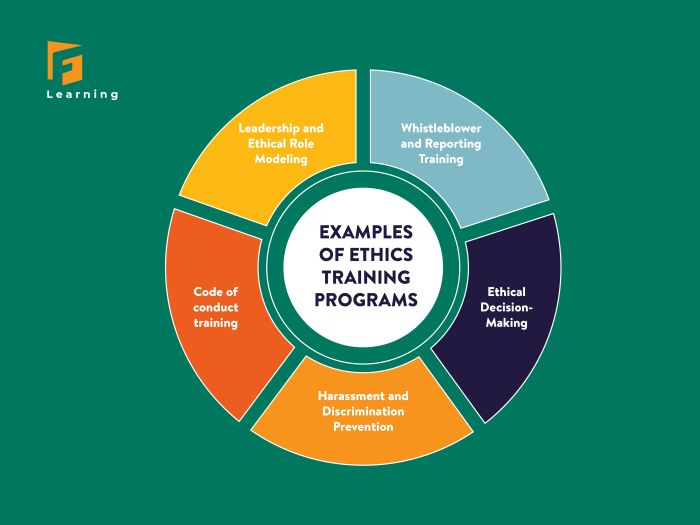
Business ethics training programs are no longer a luxury but a necessity for organizations striving for sustainable success. In today’s complex business environment, navigating ethical dilemmas is crucial for maintaining a positive reputation, fostering employee trust, and ensuring long-term profitability. This guide delves into the core components, methodologies, and impact of effective business ethics training, providing a framework for organizations to build robust programs that promote ethical conduct and responsible decision-making.
From defining the essential elements of a comprehensive program to measuring its effectiveness and integrating ethical considerations into various business functions, we explore practical strategies and tools to cultivate a culture of integrity within your organization. We examine various training formats, including online, in-person, and blended learning approaches, offering insights into best practices for designing engaging and impactful training materials.
Defining Business Ethics Training Programs
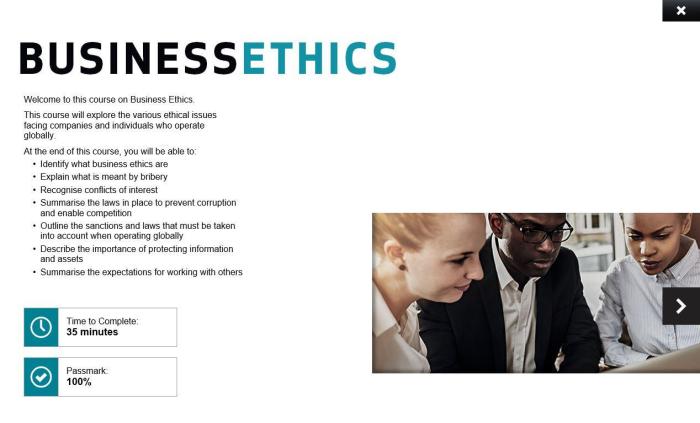
Business ethics training programs are crucial for fostering a culture of integrity and compliance within organizations. They equip employees with the knowledge and skills to navigate ethical dilemmas, understand relevant regulations, and act responsibly in their professional roles. Effective programs go beyond simply stating rules; they cultivate a deep understanding of ethical principles and their practical application.Effective business ethics training programs are characterized by several core components.
A strong foundation is laid by clearly defining the organization’s values and code of conduct. This provides a consistent framework for decision-making. Furthermore, interactive learning methods, such as case studies and role-playing, are vital for engaging participants and promoting critical thinking. Finally, a robust evaluation mechanism, including post-training assessments and ongoing reinforcement, is necessary to measure the program’s effectiveness and ensure lasting impact.
These components ensure that the training is not just informative but also transformative, leading to tangible changes in employee behavior.
Core Components of Effective Business Ethics Training Programs
Effective business ethics training programs incorporate several key elements to maximize their impact. These include:
- Clear Definition of Organizational Values and Code of Conduct: This provides a shared understanding of ethical expectations and guidelines.
- Interactive Learning Methods: Techniques like case studies, role-playing, and simulations engage participants and promote critical thinking skills.
- Real-World Examples and Case Studies: These illustrate ethical dilemmas and demonstrate the consequences of different actions.
- Relevant Laws and Regulations: Training should cover applicable laws and regulations, such as anti-bribery and anti-corruption laws.
- Reporting Mechanisms and Whistleblower Protection: Employees need to understand how to report ethical concerns and the protections afforded to whistleblowers.
- Ongoing Reinforcement and Follow-up: Regular reminders and updates ensure that ethical principles remain top-of-mind.
- Evaluation and Measurement: Post-training assessments and ongoing monitoring help evaluate the program’s effectiveness.
Methodologies Used in Delivering Business Ethics Training
A variety of methodologies can be employed to deliver business ethics training, each with its own strengths and weaknesses. The choice of methodology often depends on factors such as budget, audience size, and learning objectives.
- Lectures and Presentations: A traditional approach, suitable for conveying foundational information.
- Interactive Workshops: These encourage active participation and discussion through group activities and exercises.
- Case Studies: Analyzing real-world ethical dilemmas allows for practical application of principles.
- Role-Playing: Simulating ethical scenarios helps participants develop decision-making skills in a safe environment.
- Gamification: Using game mechanics to enhance engagement and motivation.
- E-learning Modules: Online modules provide flexibility and accessibility.
Comparison of Training Program Formats
Different formats offer varying advantages and disadvantages. The optimal format depends on the specific needs and context of the organization.
| Format | Advantages | Disadvantages |
|---|---|---|
| Online | Cost-effective, accessible, flexible scheduling | Reduced interaction, potential for lack of engagement |
| In-Person | High engagement, facilitates networking, immediate feedback | Expensive, logistically challenging, inflexible scheduling |
| Blended Learning | Combines the benefits of online and in-person, increased flexibility | Requires careful planning and coordination |
Sample Curriculum for Mid-Level Managers
This curriculum focuses on developing ethical leadership skills and decision-making abilities for mid-level managers.
- Module 1: Introduction to Business Ethics – Defining ethics, organizational values, and the importance of ethical leadership.
- Module 2: Legal and Regulatory Compliance – Review of relevant laws and regulations, including anti-bribery, anti-trust, and data privacy.
- Module 3: Ethical Decision-Making Frameworks – Exploring different models for ethical decision-making, such as utilitarianism and deontology.
- Module 4: Conflict of Interest and Transparency – Identifying and managing potential conflicts of interest, promoting transparency in business dealings.
- Module 5: Whistleblowing and Ethical Reporting – Understanding reporting mechanisms and the importance of protecting whistleblowers.
- Module 6: Corporate Social Responsibility – Exploring the role of businesses in contributing to society and the environment.
- Module 7: Ethical Leadership and Culture – Developing strategies for fostering ethical behavior within teams and departments.
The Importance of Business Ethics Training
In today’s complex and interconnected business world, ethical conduct is no longer a mere suggestion; it’s a critical component of sustainable success. A robust business ethics training program is essential for fostering a culture of integrity, mitigating risk, and ultimately driving profitability. This training equips employees with the knowledge and skills to navigate ethical dilemmas, contributing to a positive company reputation and strong financial performance.Ethical conduct significantly impacts a company’s reputation and profitability.
A strong ethical reputation attracts investors, customers, and top talent, leading to increased market share and brand loyalty. Conversely, unethical behavior, even a single instance, can inflict irreparable damage, resulting in financial losses, legal battles, and a tarnished image that takes years to rebuild. The bottom line is simple: ethical companies tend to be more successful companies.
Ethical Dilemmas and Training Solutions
Businesses regularly encounter ethical dilemmas. These can range from conflicts of interest and bribery to data privacy violations and environmental concerns. For example, a marketing team might face pressure to exaggerate product claims to meet sales targets, or a finance department might encounter pressure to manipulate financial records to improve short-term results. Effective ethics training provides employees with frameworks for analyzing these situations, identifying potential ethical violations, and making informed, responsible decisions.
It equips them with the tools to report concerns, escalate issues through proper channels, and ultimately act with integrity even under pressure. Role-playing scenarios and case studies within the training program allow employees to practice applying ethical principles in realistic situations.
Legal and Regulatory Implications of Unethical Practices
Unethical business practices carry significant legal and regulatory implications. Violations can lead to hefty fines, lawsuits, and even criminal charges. For instance, anti-trust violations, insider trading, and environmental regulations are strictly enforced, with severe consequences for non-compliance. Comprehensive ethics training helps companies avoid these costly and damaging outcomes by providing employees with a clear understanding of relevant laws and regulations.
This training also fosters a culture of compliance, encouraging employees to adhere to legal and ethical standards in their daily work. This proactive approach reduces the risk of legal challenges and protects the company’s reputation and financial stability.
Case Studies Demonstrating Positive Outcomes
Numerous case studies demonstrate the positive impact of comprehensive ethics training. For example, a company that implemented a robust ethics program saw a significant reduction in reported misconduct, leading to improved employee morale and increased trust among stakeholders. Another company that experienced a major ethical crisis leveraged its ethics training program to navigate the situation effectively, mitigating reputational damage and maintaining stakeholder confidence.
These examples illustrate that investment in ethics training is not merely a cost, but a strategic investment that protects a company’s bottom line and enhances its long-term sustainability. A commitment to ethical conduct, reinforced through consistent and effective training, is an essential element of a successful and responsible business.
Measuring the Effectiveness of Business Ethics Training Programs
Evaluating the success of a business ethics training program requires a multifaceted approach that goes beyond simple attendance records. A robust evaluation framework should measure changes in employee knowledge, attitudes, and, most importantly, behavior. This ensures that the training translates into tangible improvements in ethical conduct within the organization.A comprehensive evaluation strategy incorporates various methods to gauge the program’s effectiveness across different dimensions.
This includes pre- and post-training assessments, observation of workplace behavior, and analysis of reported ethical dilemmas. The ultimate goal is to demonstrate a clear link between the training and a demonstrably more ethical work environment.
A Framework for Evaluating Training Program Success
This framework utilizes a three-pronged approach focusing on cognitive understanding, behavioral changes, and organizational impact. Each component relies on specific metrics and data collection methods to provide a holistic assessment. The framework’s flexibility allows for adaptation to suit the specific context and objectives of the training program.
Key Performance Indicators (KPIs) for Tracking Training Impact
Several key performance indicators (KPIs) can effectively track the impact of business ethics training. These indicators provide quantifiable measures of success across various aspects of the program. Using a combination of these KPIs offers a comprehensive view of the program’s effectiveness.
- Pre- and Post-Training Knowledge Assessments: Measure the increase in employee understanding of ethical principles and company policies through pre- and post-training tests. A significant improvement in scores indicates successful knowledge transfer.
- Changes in Ethical Behavior: Track the number of reported ethical violations before and after the training. A decrease suggests improved ethical conduct. This could be tracked through internal reporting systems or employee surveys.
- Employee Attitudes and Perceptions: Gauge shifts in employee attitudes toward ethical conduct using surveys that assess their commitment to ethical principles and their perception of the company’s ethical culture. A positive change reflects the training’s influence on employee values.
- Improved Reporting of Ethical Concerns: Monitor the number of ethical concerns reported by employees. An increase might indicate that employees feel more empowered to report issues, a positive sign of a strengthened ethical culture.
- Reduction in Compliance Violations: Track the number of compliance violations before and after the training. A reduction demonstrates the training’s success in promoting adherence to regulations and company policies.
Survey Design to Assess Employee Understanding and Application of Ethical Principles
A post-training survey should assess both the cognitive understanding and the behavioral application of ethical principles. The survey should employ a mix of question types, including multiple-choice, short-answer, and scenario-based questions.The survey should include questions measuring comprehension of key ethical concepts covered in the training, as well as questions assessing employees’ ability to apply these concepts to hypothetical workplace situations.
For example, a scenario might present an ethical dilemma and ask employees to identify the best course of action, justifying their response. The survey should also include questions regarding employee confidence in handling ethical situations and their perception of the company’s ethical climate. Anonymous responses are crucial to encourage honest feedback.
Data Collection Methods for Measuring Changes in Employee Behavior
Measuring changes in employee behavior after training requires a combination of quantitative and qualitative data collection methods. This approach provides a comprehensive understanding of the training’s impact on ethical conduct.
- Observation of Workplace Behavior: Managers can observe employees’ behavior in the workplace, noting instances of ethical or unethical conduct. This approach, however, requires careful consideration to avoid bias and ensure consistency in observation.
- Analysis of Internal Reports: Review internal reports of ethical violations or compliance issues to track changes in the frequency of such incidents. A decrease in reported violations suggests a positive impact of the training.
- Focus Groups and Interviews: Conduct focus groups or individual interviews with employees to gather qualitative data on their experiences and perceptions of the training’s effectiveness. This approach allows for a deeper understanding of the training’s impact on employee attitudes and behavior.
- Analysis of Employee Feedback: Regularly solicit employee feedback through surveys, suggestion boxes, or other channels to identify areas for improvement in the training program or in the company’s ethical culture.
Integrating Business Ethics with Other Business Functions
Effective business ethics training isn’t a standalone program; it’s a crucial component interwoven into the fabric of a successful and sustainable organization. Integrating ethical considerations into various business functions ensures alignment between values and practices, ultimately fostering a positive impact on stakeholders and long-term profitability. This integration enhances the overall effectiveness of business strategies and operations.
Business Ethics Training and Business Development Strategies
Business ethics training directly supports business development strategies by fostering a culture of trust and integrity. When employees understand and adhere to ethical principles, they are more likely to make responsible decisions that benefit the organization in the long run. For example, a company prioritizing ethical sourcing can build a stronger brand reputation, attracting customers who value sustainability and ethical practices.
This positive brand image translates into increased sales and market share, directly contributing to business development goals. Furthermore, ethical conduct reduces the risk of legal repercussions and reputational damage, freeing up resources that can be invested in growth initiatives. A robust ethics program ensures that business development strategies are not only profitable but also ethically sound.
The Roles of Business Coaching and Business Ethics Training in Employee Development
While both business coaching and business ethics training contribute to employee development, they address different aspects. Business coaching focuses on individual performance improvement, skill enhancement, and career advancement. Business ethics training, on the other hand, emphasizes the ethical dimensions of decision-making, fostering a shared understanding of organizational values and promoting responsible conduct. Ideally, these two approaches are complementary.
Business coaching can help employees translate ethical principles into practical actions in their daily work, while ethics training provides the foundational framework for ethical decision-making. For instance, a business coach might help an employee improve their negotiation skills, while ethics training ensures they negotiate fairly and transparently, avoiding conflicts of interest. Together, they create a well-rounded approach to employee development that prioritizes both individual success and ethical conduct.
Business Ethics Training and the Creation of a Sustainable Business Model
A sustainable business model requires a long-term perspective that considers environmental, social, and governance (ESG) factors. Business ethics training plays a vital role in building this perspective within an organization. By incorporating ethical considerations into all aspects of the business, from product development to supply chain management, companies can create more sustainable practices. For example, training employees on responsible waste management and environmental protection can lead to reduced environmental impact and cost savings.
Similarly, training on fair labor practices can improve employee morale and reduce the risk of ethical violations, contributing to a more sustainable and responsible business model. This commitment to ethical practices not only reduces risk but also enhances the company’s reputation, attracting investors and customers who prioritize sustainability.
Ethical Considerations in Business Loan Applications and Processes
Ethical considerations are paramount in business loan applications and processes. Transparency and accuracy in financial reporting are crucial. Misrepresenting financial information to secure a loan is unethical and illegal. Lenders, too, have an ethical obligation to assess applications fairly and avoid discriminatory practices. They must ensure that loan terms are clear and understandable, and that borrowers are not subjected to predatory lending practices.
The entire process, from application to repayment, should be governed by principles of fairness and integrity. For example, a lender might refuse a loan application if the applicant’s financial statements are unclear or inconsistent, even if the applicant’s business appears otherwise viable. This demonstrates a commitment to ethical lending practices and safeguards against potential risks.
Ethical Implications of Different Business Strategies and Their Impact on Stakeholders
Different business strategies have varying ethical implications depending on their impact on stakeholders, including employees, customers, suppliers, communities, and the environment. For example, a cost-cutting strategy that involves layoffs without adequate support for affected employees can be considered unethical. Conversely, a strategy focused on innovation and sustainable practices can have a positive impact on all stakeholders. The ethical implications must be carefully considered during the strategic planning process.
A company that prioritizes profit maximization above all else may engage in unethical practices to achieve its goals, potentially damaging its reputation and long-term viability. A holistic approach that considers the ethical implications of different strategies ensures a sustainable and responsible approach to business.
Ethical Considerations Related to Business Travel and Expense Management
Business travel and expense management require careful ethical consideration to avoid conflicts of interest and ensure transparency. Employees should adhere to company policies regarding travel arrangements and expense reimbursements. Unnecessary or extravagant spending should be avoided, and receipts should be properly documented. For instance, choosing economy airfare instead of first-class unless it’s absolutely necessary for business reasons demonstrates responsible spending.
Similarly, transparent expense reports and clear guidelines for reimbursements prevent potential misuse of company funds and maintain trust among employees and management. Regular audits and training can help reinforce ethical behavior in this area.
Creating Engaging and Effective Training Materials
Effective business ethics training requires more than just lectures; it demands engaging and memorable learning experiences. Participants need to actively grapple with ethical dilemmas, internalize principles, and develop practical skills for navigating complex situations. This section explores methods for creating impactful training materials.
Sample Ethical Dilemmas in Business Functions
To foster critical thinking, real-world scenarios are crucial. The following table presents ethical dilemmas relevant to various business functions, offering potential solutions and outlining their consequences. These scenarios can be adapted and expanded upon to suit the specific context of your organization.
| Scenario | Ethical Issue | Potential Solutions | Consequences |
|---|---|---|---|
| A marketing manager is pressured to release a product with known minor defects to meet a deadline and boost quarterly profits. | Compromising product safety and consumer trust for short-term gains. | Delay the product launch to fix the defects; inform upper management of the risks; implement a robust quality control system. | Delayed profits, potential legal repercussions (product liability), damage to brand reputation (delayed launch vs. product recall). |
| A software engineer discovers a security vulnerability in their company’s flagship product but is worried about the impact on the company’s reputation if disclosed. | Balancing ethical responsibility to disclose vulnerabilities versus protecting the company’s interests. | Report the vulnerability internally through established channels; follow established protocols for vulnerability disclosure; consider consulting external ethical hacking experts. | Positive impact on brand reputation if handled transparently and effectively; negative impact if the vulnerability is exploited before remediation. |
| A sales representative is offered a significant bribe by a potential client in exchange for securing a lucrative contract. | Bribery and corruption, conflict of interest. | Refuse the bribe and report the incident to their supervisor; document the interaction; adhere to the company’s code of conduct. | Loss of a potential client (but maintaining ethical integrity); potential disciplinary action against the client; upholding the company’s reputation. |
| A human resources manager discovers evidence of discrimination against a particular demographic within the company. | Discrimination, violation of equal opportunity employment laws. | Initiate a thorough investigation; report the findings to upper management; implement corrective actions and diversity training. | Legal repercussions, damage to brand reputation, loss of employee morale, potential financial penalties. |
Infographic: Benefits of Ethical Business Practices
This infographic uses a circular design, symbolizing the cyclical and interconnected nature of ethical business practices and their benefits. The central image is a stylized tree, its roots representing ethical foundations (integrity, transparency, accountability), its trunk representing ethical actions, and its branches representing positive outcomes. The color palette is predominantly green (representing growth and sustainability) and blue (representing trust and stability).
The font is clean and modern, using a sans-serif typeface for readability. Data is presented using icons and percentages, visually demonstrating the impact of ethical practices on various aspects of the business. For example, one segment might show that companies with strong ethical cultures experience a 20% higher employee retention rate compared to their less ethical counterparts (based on a hypothetical study, to be replaced with actual data from a reputable source).
Role-Playing Exercise: Navigating Ethical Challenges
This exercise simulates a workplace scenario where participants must navigate an ethical dilemma. Participants are divided into groups, each assigned roles within a fictional company facing a specific ethical challenge (e.g., a conflict of interest involving a senior manager, a whistleblower situation). The exercise facilitator provides a brief scenario description and then allows the groups to role-play, discussing the dilemma, exploring potential solutions, and considering the consequences of each action.
Scenario: A junior employee witnesses a senior manager falsifying expense reports. Roles: Junior employee, senior manager, ethics officer. Potential Dialogue:Junior Employee: “I’m not sure what to do. I saw Mr. Jones altering his expense reports.” Senior Manager: “It’s just a small thing.
Don’t worry about it.” Ethics Officer: “We need to follow company policy. Falsifying expense reports is a serious breach of ethics.”
Short Videos: Ethical Principles in Business
A series of short videos (3-5 minutes each) will be created to illustrate key ethical principles. Each video will feature a real-world business scenario and explain how ethical principles are applied to find a solution. These videos are targeted at all employees, regardless of their roles or seniority levels.* Video 1: Integrity: This video focuses on the importance of honesty and truthfulness in business dealings, using a scenario of a sales representative facing pressure to misrepresent a product’s capabilities.
Target audience: all employees.* Video 2: Fairness: This video explores the concept of equitable treatment and non-discrimination in the workplace, showcasing a scenario where a manager needs to fairly distribute workload among team members. Target audience: all employees, especially managers and supervisors.* Video 3: Accountability: This video emphasizes the importance of taking responsibility for one’s actions, using a scenario where an employee makes a mistake and must take ownership of it.
Target audience: all employees.* Video 4: Respect: This video discusses the significance of treating all stakeholders with respect and dignity, illustrating a scenario of a customer service interaction where a customer is upset. Target audience: all employees, especially those in customer-facing roles.
Ultimately, the success of any business ethics training program hinges on its ability to translate theoretical knowledge into practical application. By implementing a well-structured program that incorporates diverse methodologies, measures its effectiveness through clear KPIs, and integrates ethical considerations into all aspects of the business, organizations can cultivate a culture of ethical conduct, build strong stakeholder relationships, and achieve sustainable growth.
The investment in such training is not merely a compliance exercise; it is a strategic imperative for long-term success and responsible business leadership.
User Queries
What are the potential penalties for unethical business practices?
Penalties can range from hefty fines and legal repercussions to reputational damage, loss of investor confidence, and even criminal charges depending on the severity and nature of the unethical conduct.
How often should business ethics training be conducted?
Frequency depends on industry, company size, and risk profile. Annual refresher training is common, but some organizations opt for more frequent sessions, especially following significant changes or incidents.
How can I ensure my employees actively participate in the training?
Employ interactive methods like role-playing, case studies, and group discussions. Gamification and personalized learning pathways can also boost engagement.
How do I measure the ROI of business ethics training?
Track key metrics like employee awareness of ethical policies, reported instances of unethical behavior, and improvements in company reputation and compliance scores.