
Navigating the complexities of growth and market dominance often hinges on a clear understanding of strategic direction. While both corporate and business strategies contribute to overall success, their scopes and approaches differ significantly. This exploration delves into the core distinctions between these vital strategic frameworks, examining how they interact, complement each other, and ultimately drive organizational performance. We’ll analyze successful and unsuccessful implementations, highlighting the critical role of ethical considerations and the impact of supporting factors like business development and coaching.
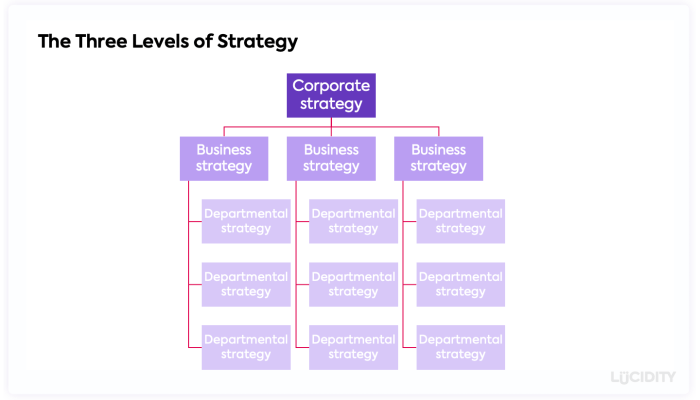
Understanding the difference between corporate and business strategy is crucial for any organization aiming for sustainable growth. Corporate strategy sets the overarching direction, defining the overall goals and long-term vision for the entire enterprise. In contrast, business strategy focuses on specific market segments and competitive advantages within individual business units. The interplay between these two levels of strategy is dynamic and requires careful coordination to ensure alignment and effective resource allocation.
This analysis will provide a framework for understanding this complex relationship and its implications for organizational success.
Ethical Considerations in Corporate and Business Strategy
Ethical considerations are no longer optional add-ons to corporate and business strategies; they are integral components of long-term success. Ignoring ethical implications can lead to reputational damage, legal repercussions, and ultimately, business failure. A strong ethical framework ensures sustainable growth while fostering trust with stakeholders, including employees, customers, investors, and the wider community.Integrating ethical considerations into strategic decision-making requires a proactive and holistic approach, encompassing sustainability, social responsibility, and fair competition.
This involves a commitment to transparency, accountability, and a genuine desire to operate ethically at all levels of the organization.
Sustainability Practices in Corporate Strategy
Companies are increasingly recognizing the importance of environmental sustainability. This involves reducing their environmental footprint through measures like minimizing waste, conserving energy, and utilizing sustainable materials. For example, Patagonia, an outdoor clothing company, has long been a leader in sustainable business practices, using recycled materials, supporting environmental causes, and actively working to reduce its carbon emissions. Their commitment to sustainability has not only enhanced their brand image but also attracted environmentally conscious consumers.
This demonstrates how ethical practices can translate into both social and economic benefits.
Social Responsibility Initiatives
Social responsibility encompasses a company’s commitment to acting in a way that benefits society. This includes fair labor practices, community involvement, and philanthropic activities. Unilever, a multinational consumer goods company, has implemented numerous social responsibility initiatives, focusing on improving health and hygiene in developing countries, supporting sustainable agriculture, and promoting gender equality within its workforce. These initiatives not only improve the lives of people globally but also strengthen Unilever’s brand reputation and attract talent.
Fair Competition and Ethical Business Conduct
Maintaining fair competition and ethical business conduct is crucial for a healthy market economy. This involves avoiding anti-competitive practices, such as price-fixing or bid-rigging, and upholding intellectual property rights. Conversely, engaging in unethical practices can lead to significant fines and reputational damage. Companies that prioritize fair competition often build stronger, more lasting relationships with their customers and partners.
Ethical Guidelines for Developing and Implementing Corporate and Business Strategies
Developing and implementing ethical corporate and business strategies requires a clear set of guidelines. These guidelines should be integrated into the company’s culture and values, and regularly reviewed and updated.
The following bullet points Artikel key ethical considerations:
- Transparency and Accountability: Maintain open communication with stakeholders about the company’s ethical practices and performance.
- Stakeholder Engagement: Actively involve stakeholders in the decision-making process, considering their perspectives and concerns.
- Compliance with Laws and Regulations: Adhere to all applicable laws and regulations related to ethical business conduct.
- Environmental Sustainability: Minimize environmental impact through sustainable practices and responsible resource management.
- Social Responsibility: Contribute positively to society through community involvement and philanthropic activities.
- Fair Competition: Engage in fair and ethical business practices, avoiding anti-competitive behaviors.
- Data Privacy and Security: Protect the privacy and security of customer and employee data.
- Whistleblower Protection: Establish mechanisms for employees to report ethical concerns without fear of retaliation.
- Regular Ethical Audits: Conduct regular audits to assess the effectiveness of ethical policies and procedures.
The Impact of Business Coaching on Strategy Implementation
Effective strategy implementation hinges on more than just a well-crafted plan; it requires strong leadership, a culture of accountability, and the ability to navigate inevitable obstacles. Business coaching plays a crucial role in bolstering these critical elements, significantly increasing the likelihood of achieving strategic goals. By providing targeted support and development to leaders and teams, business coaching empowers organizations to translate their strategies into tangible results.Business coaching supports the implementation of corporate and business strategies by enhancing leadership capabilities and improving organizational effectiveness.
Coaches work with leaders at all levels, providing personalized guidance to improve their decision-making, communication, and problem-solving skills. This, in turn, strengthens the organization’s capacity to execute the strategic plan efficiently and effectively. Furthermore, coaching fosters a collaborative environment where teams are empowered to contribute their expertise and work together towards shared objectives. The improved communication and collaboration facilitated by coaching directly impact the speed and effectiveness of strategy implementation.
Benefits of Business Coaching in Fostering Accountability and Goal Achievement
Accountability is a cornerstone of successful strategy implementation. Business coaching helps cultivate a culture of accountability by clarifying roles, responsibilities, and performance expectations. Coaches work with individuals and teams to establish clear metrics for success, track progress, and identify areas for improvement. This transparent approach ensures that everyone understands their contribution to the overall strategic goals and is held responsible for their performance.
Moreover, coaching provides a safe space for individuals to address challenges and seek support, fostering a culture of continuous learning and improvement that is vital for achieving ambitious strategic goals. For example, a company implementing a new customer relationship management (CRM) system might use coaching to ensure all sales teams understand their new responsibilities and use the system effectively, thereby contributing to increased sales and improved customer satisfaction.
Overcoming Obstacles Through Business Coaching
Implementing any strategy inevitably involves encountering unforeseen challenges. A scenario where business coaching proves invaluable is during periods of significant organizational change. For instance, consider a company undergoing a merger or acquisition. The integration process is complex, requiring careful management of diverse teams, cultures, and systems. Business coaching can be instrumental in navigating these complexities.
Coaches can work with leaders to address conflict, build trust, and facilitate communication across different departments and teams. They can also help individuals manage stress and adapt to new roles and responsibilities, minimizing disruption and maximizing the chances of a successful integration. By providing a structured approach to problem-solving and conflict resolution, business coaching helps to mitigate the risks associated with organizational change and ensure the smooth implementation of the post-merger strategy.
Financing Strategies
Securing adequate funding is paramount for successful strategy implementation. The choice of financing strategy, whether through business loans or internal resources, significantly impacts a company’s ability to achieve its strategic objectives. This section examines the role of business loans in supporting strategic initiatives and compares various business models and their funding implications.The Role of Business Loans in Strategy ImplementationBusiness loans provide crucial capital for businesses to pursue their strategic goals.
These loans can fund expansion projects, research and development, marketing campaigns, or working capital needs. Access to loans allows businesses to accelerate growth, seize market opportunities, and overcome financial hurdles that might otherwise impede strategic progress. The terms of a loan – interest rates, repayment schedules, and collateral requirements – should be carefully considered and aligned with the company’s strategic timeline and risk tolerance.
For example, a company aiming for rapid expansion might opt for a short-term loan with a higher interest rate, while a company focusing on sustainable growth might prefer a longer-term loan with lower interest. Careful financial planning and a strong business plan are essential for securing favorable loan terms.
Business Models and Funding Requirements
Different business models necessitate distinct funding approaches. A subscription-based model, for example, might require less upfront capital compared to a capital-intensive manufacturing business. Understanding the inherent funding needs of a chosen business model is crucial for securing appropriate financing and achieving strategic objectives. A mismatch between the business model and the funding strategy can lead to financial instability and hinder the implementation of strategic plans.
| Business Model | Funding Requirements | Typical Funding Sources | Strategic Implications |
|---|---|---|---|
| Subscription-based | Moderate upfront investment, ongoing operational costs | Venture capital, angel investors, bootstrapping, bank loans | Predictable revenue streams, potential for recurring revenue, scalability challenges |
| Freemium | High initial development costs, marketing expenses | Venture capital, angel investors, crowdfunding | Large user base potential, monetization challenges, need for effective user acquisition strategies |
| Franchise | Significant upfront franchise fees, ongoing royalty payments | Bank loans, personal savings, franchise financing | Rapid expansion potential, brand recognition, reliance on franchisee performance |
| E-commerce | Website development, inventory management, marketing costs | Small business loans, online lenders, venture capital | Scalability potential, global reach, competition from established players |
Ultimately, the success of any organization depends on the synergistic relationship between its corporate and business strategies. A well-defined corporate strategy provides the overarching framework, while effective business strategies ensure that individual units are optimally positioned to achieve the overall goals. By understanding the nuances of each, aligning them effectively, and incorporating ethical considerations and supportive elements like business development and coaching, organizations can create a powerful engine for sustainable growth and long-term success.
The key takeaway is that these strategies are not mutually exclusive but rather interdependent components of a holistic approach to organizational management.
Quick FAQs
What is the main difference between a corporate and a business strategy?
Corporate strategy focuses on the overall direction of the entire organization, while business strategy focuses on the competitive advantage and market position of a specific business unit within that organization.
How often should these strategies be reviewed and updated?
Both strategies should be regularly reviewed, ideally annually, or more frequently if market conditions or internal factors necessitate change. Flexibility and adaptability are key.
Can a small business have both a corporate and business strategy?
Yes, even small businesses can benefit from a clearly defined corporate strategy (overall vision) and a business strategy (how they will achieve it within their market). The complexity might be less, but the principles remain the same.
What happens if corporate and business strategies are misaligned?
Misalignment leads to resource conflicts, duplicated efforts, and ultimately, reduced efficiency and potential failure to achieve overall organizational goals. Internal conflict and poor performance often result.


