Navigating the complexities of small business ownership can feel daunting, but with the right guidance, success is within reach. This guide provides a comprehensive overview of key strategies for developing and growing your small business, from understanding your target market to implementing effective marketing and financial management techniques. We’ll explore crucial aspects such as securing funding, building a strong brand, and fostering ethical business practices, equipping you with the knowledge to build a thriving enterprise.
From crafting a compelling business plan and securing necessary funding to implementing effective marketing strategies and managing your finances efficiently, this resource offers actionable steps and insightful advice to help your business flourish. We delve into the nuances of various business models, the importance of ethical considerations, and the potential benefits of seeking business coaching, offering a holistic approach to sustainable business growth.
Developing a Solid Business Plan
A well-structured business plan is crucial for securing funding, guiding operations, and achieving long-term success. It serves as a roadmap, outlining your business goals, strategies, and financial projections. A comprehensive plan demonstrates your understanding of the market and your commitment to your venture.
Bakery Business Plan: Financial Projections
This section details the financial projections for a new bakery, “Sweet Success.” We will illustrate key financial aspects using realistic examples and estimations based on industry averages and comparable businesses. The plan will include projected revenue based on estimated sales volume and pricing, cost of goods sold factoring in ingredient costs and labor, and operating expenses encompassing rent, utilities, and marketing.
Profitability will be assessed through projected net income, considering all revenue and expenses. A crucial element is the break-even analysis, which projects when the bakery will become profitable. For example, if the projected monthly revenue is $10,000 and the monthly expenses are $7,000, the monthly net profit is $3,000. This can be further analyzed by calculating the break-even point (the point at which total revenue equals total costs) which is crucial for investment decisions.
A detailed cash flow projection, showing anticipated inflows and outflows of cash, will also be included to ensure sufficient working capital. Finally, a sensitivity analysis will examine the impact of potential changes in key assumptions, like ingredient costs or sales volume.
Home-Based Cleaning Service Business Plan: Key Components
A successful business plan for a home-based cleaning service, “CleanSweep,” needs to focus on several key areas. The executive summary should concisely Artikel the business concept, target market, and financial highlights. The market analysis should identify the competition, target customer demographics (e.g., busy professionals, families), and pricing strategies. The marketing and sales strategy will detail how CleanSweep will attract and retain clients (e.g., online advertising, word-of-mouth referrals, local partnerships).
The operations plan will describe the cleaning services offered, equipment needed, and scheduling procedures. The management team section will highlight the owner’s experience and expertise in cleaning or business management. Finally, the financial projections, similar to the bakery example, will include startup costs, projected revenue, and profitability analysis. For instance, CleanSweep might project a certain number of clients per week at a specific price point, allowing for calculation of revenue and expenses to determine profitability.
Startup Funding Strategy
Securing funding is a vital aspect of launching any business. A robust funding strategy involves identifying the necessary capital, determining the appropriate funding sources, and developing a compelling pitch to attract investors. This strategy might involve bootstrapping (using personal savings), seeking loans from banks or credit unions, exploring crowdfunding platforms, or attracting angel investors or venture capital. For example, a tech startup might initially bootstrap using founder savings and then seek seed funding from angel investors to support initial product development.
Following successful product launch and initial traction, they might then pursue Series A funding from venture capitalists for expansion. The funding strategy should clearly Artikel the amount of funding needed, the intended use of funds, and the proposed return on investment for potential investors.
Sample Business Plan Structure
A standard business plan follows a consistent structure. The executive summary provides a concise overview of the entire plan, highlighting key aspects of the business. The company description details the business’s mission, vision, and legal structure. The market analysis identifies the target market, competition, and market trends. The organization and management section describes the business structure and the management team.
The service or product line section Artikels the offerings and their unique selling propositions. The marketing and sales strategy details the plan to reach and acquire customers. The funding request (if applicable) Artikels the amount of funding sought and its intended use. The financial projections include projected income statements, balance sheets, and cash flow statements. Finally, the appendix contains supporting documents, such as market research data or resumes of key personnel.
This structured approach ensures a comprehensive and persuasive business plan.
Securing Funding and Financing
Securing the necessary capital is a crucial step in establishing and growing a small business. Understanding the various funding options available, their associated benefits and drawbacks, and how to present your business effectively to potential investors are key to success. This section will explore different funding avenues and strategies for securing the financial resources your business needs.
Small Business Loan Options
Choosing the right loan is paramount. Different loan types cater to varying needs and risk profiles. A thorough understanding of each option is essential before making a decision.
Several types of small business loans exist, each with its own advantages and disadvantages:
- Term Loans: These offer a fixed amount of money repaid over a set period with fixed interest rates. Advantages include predictable payments and potentially lower interest rates than other options. Disadvantages include the potential for higher initial interest rates and the requirement of strong credit history.
- Lines of Credit: These provide access to a pre-approved amount of money that can be borrowed and repaid multiple times within a specific period. Advantages include flexibility and the ability to borrow only what is needed. Disadvantages include potentially higher interest rates than term loans and the risk of accruing debt if not managed carefully.
- SBA Loans: Backed by the Small Business Administration, these loans often come with lower interest rates and longer repayment terms than conventional loans. Advantages include favorable terms and government support. Disadvantages include a more rigorous application process and the need to meet specific eligibility criteria.
- Microloans: Smaller loans, often provided by non-profit organizations, ideal for startups with limited collateral. Advantages include easier access to funding for businesses with limited credit history. Disadvantages include smaller loan amounts and potentially higher interest rates.
Bootstrapping versus Venture Capital
Bootstrapping and venture capital represent distinct approaches to securing funding. Each strategy has its own merits and drawbacks that entrepreneurs must carefully consider.
Bootstrapping involves funding a business solely through personal savings, revenue, and loans from friends and family. Venture capital, on the other hand, involves securing investment from external investors in exchange for equity in the company.
Bootstrapping Advantages: Maintains complete control, avoids dilution of ownership, and allows for a slower, more controlled growth trajectory. Bootstrapping Disadvantages: Limited funding potential, slower growth, and higher personal risk.
Venture Capital Advantages: Access to significant capital, faster growth potential, and valuable expertise from investors. Venture Capital Disadvantages: Loss of equity, relinquishing control, and pressure to meet investor expectations.
Creating a Compelling Pitch Deck
A well-structured pitch deck is crucial for attracting investors. It serves as a concise summary of your business plan, highlighting key aspects and showcasing your vision.
A compelling pitch deck typically includes:
- Problem: Clearly define the problem your business solves.
- Solution: Explain your product or service and how it addresses the problem.
- Market Analysis: Demonstrate market size, target audience, and competitive landscape.
- Business Model: Artikel your revenue streams and cost structure.
- Team: Showcase the experience and expertise of your team.
- Financial Projections: Present realistic financial forecasts.
- Funding Request: Specify the amount of funding sought and its intended use.
Key Financial Metrics for Investors
Investors assess the financial health and potential of a business based on several key metrics. Understanding these metrics is vital for presenting a strong case for investment.
Investors typically focus on:
- Revenue: Demonstrates the business’s ability to generate income.
- Profitability (Net Income): Shows the business’s ability to generate profit after all expenses.
- Cash Flow: Indicates the business’s ability to manage its cash inflows and outflows.
- Customer Acquisition Cost (CAC): Measures the cost of acquiring a new customer.
- Customer Lifetime Value (CLTV): Estimates the total revenue generated by a customer over their relationship with the business.
- Burn Rate: Tracks the rate at which the business is spending cash.
Effective Marketing and Sales Strategies
Effective marketing and sales strategies are crucial for the success of any business, regardless of size or industry. A well-defined strategy allows businesses to reach their target audience, build brand awareness, and ultimately drive sales. This section will explore several key strategies, focusing on practical applications for different business models.
Social Media Marketing Plan for a Local Restaurant
A robust social media strategy for a local restaurant should leverage visual platforms to showcase appealing food photography and videos. This could include behind-the-scenes glimpses of the kitchen, chef interviews, or customer testimonials. Regular posting is essential, with a mix of content types—high-quality images, short videos, stories, and engaging captions—to maintain audience interest. Running targeted advertising campaigns on platforms like Facebook and Instagram can also significantly increase reach and brand visibility within the local community.
Utilizing location-based tagging and engaging with local influencers can further enhance the restaurant’s online presence. Regular contests and promotions, such as offering discounts or giveaways, can boost engagement and drive customer traffic. Finally, consistently monitoring and responding to customer comments and reviews is critical for building a positive online reputation.
Content Marketing Strategy for a Small Online Retailer
For a small online retailer, content marketing should focus on providing valuable information to potential customers. This could involve creating blog posts about product usage, style guides, or care instructions. High-quality product photography and detailed descriptions are paramount. Producing informative videos demonstrating product features or showcasing customer testimonials can significantly improve conversion rates. Collaborating with relevant bloggers or influencers for product reviews or sponsored content can extend the reach of the retailer’s marketing efforts.
Search engine optimization () is crucial for ensuring that the retailer’s website and content rank highly in search results for relevant s. Finally, email marketing can be used to nurture leads, announce new products, and offer exclusive discounts to loyal customers.
Strategies for Building Brand Awareness on a Limited Budget
Building brand awareness on a limited budget requires creative and strategic thinking. Leveraging free or low-cost marketing channels is key. This includes optimizing the business’s website for search engines (), actively engaging with customers on social media, and participating in relevant local events or community initiatives. Creating high-quality, shareable content, such as blog posts, infographics, or videos, can help spread brand awareness organically.
Collaborating with other businesses or influencers for cross-promotional opportunities can also be highly effective. Running targeted email marketing campaigns to existing customers and subscribers can help nurture relationships and build brand loyalty. Finally, consistently monitoring online reviews and responding to customer feedback can build trust and enhance the brand’s reputation.
Comparison of Digital Marketing Channels for a Service-Based Business
A service-based business can utilize various digital marketing channels to reach its target audience. The effectiveness of each channel depends on factors such as the target audience, budget, and business goals. The following table compares four common digital marketing channels:
| Channel | Cost | Reach | Effectiveness for Service Businesses |
|---|---|---|---|
| Search Engine Optimization () | Variable (can be high initially, but long-term cost-effective) | High (organic reach) | Excellent for attracting clients searching for specific services online. |
| Social Media Marketing | Variable (from free organic posts to paid advertising) | Medium to High (depending on budget and targeting) | Effective for building brand awareness, engaging with potential clients, and showcasing expertise. |
| Email Marketing | Low (cost of email marketing platform) | Medium (targeted reach to subscribers) | Excellent for nurturing leads, announcing new services, and promoting special offers. |
| Paid Advertising (PPC) | High (cost per click varies) | High (targeted reach) | Effective for driving immediate traffic to the website and generating leads. |
Managing Finances and Operations
Effective financial management is crucial for the long-term success of any small business. Without a solid grasp of your finances and efficient operational procedures, even the best business ideas can falter. This section Artikels key strategies for managing your finances and operations to ensure sustainable growth.
Cash Flow Management Best Practices
Maintaining positive cash flow is paramount. This involves carefully monitoring the inflow and outflow of money to ensure you always have enough to cover expenses. Strategies include proactive invoicing, negotiating favorable payment terms with suppliers, and offering early payment discounts to clients. Regularly forecasting cash flow allows for proactive planning and helps identify potential shortfalls before they become crises.
For example, a seasonal business might experience a surge in sales during certain periods but a lull in others; forecasting helps anticipate and mitigate the cash flow dips during the slower seasons. This could involve securing a line of credit to bridge the gap or adjusting marketing strategies to generate sales during the quieter periods.
Accurate Record-Keeping and Financial Reporting
Accurate and up-to-date financial records are essential for making informed business decisions, securing loans, and complying with tax regulations. This includes meticulous tracking of all income and expenses, maintaining accurate inventory records (if applicable), and preparing regular financial statements like profit and loss statements and balance sheets. These records provide a clear picture of the business’s financial health, highlighting areas of strength and weakness.
For instance, a detailed expense report can pinpoint areas where costs can be reduced, improving profitability. Regular financial reporting also allows for early detection of potential problems, enabling timely intervention and preventing larger issues down the line.
Creating a Simple Budgeting System
A well-defined budget is a roadmap for your finances. A simple budgeting system can be created by first estimating your monthly income. Next, categorize your expenses into fixed costs (rent, salaries) and variable costs (utilities, marketing). Then, allocate funds to each category based on historical data or projections. Regularly compare your actual spending against your budget to identify discrepancies and make necessary adjustments.
For example, if marketing expenses consistently exceed the budget, you might need to re-evaluate your marketing strategies to find more cost-effective options. This iterative process ensures the budget remains relevant and effective over time.
Benefits of Accounting Software for Small Businesses
Accounting software streamlines financial management, automating tasks like invoice generation, expense tracking, and financial reporting. Features such as automated bank reconciliation, inventory management, and tax preparation capabilities significantly reduce administrative burden and increase accuracy. Many affordable options are available tailored to the needs of small businesses, offering a significant return on investment in terms of time saved and improved financial oversight.
Using such software can provide valuable insights into your business’s performance, enabling data-driven decision-making and fostering greater financial control. For example, software can generate reports that show sales trends, identifying best-selling products or services and informing future inventory decisions.
Business Development Strategies
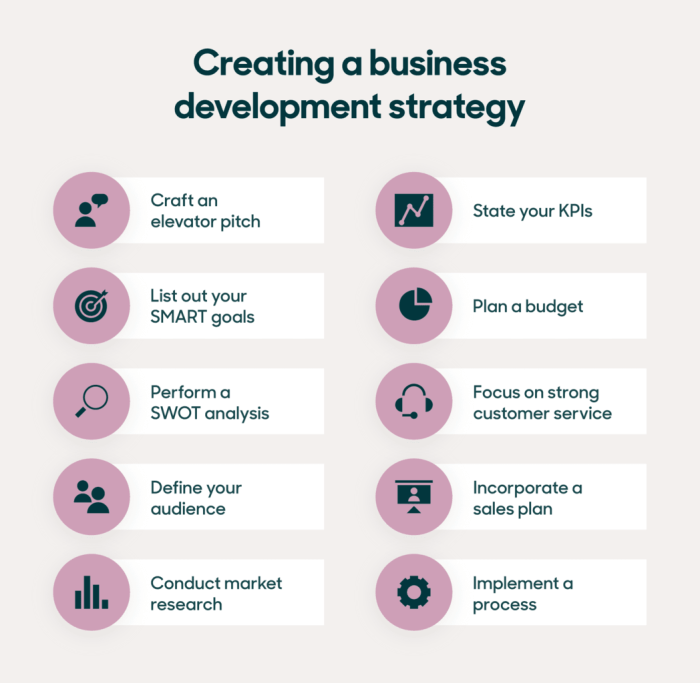
Business development is the process of creating and implementing strategies to grow a business. It encompasses a wide range of activities, from identifying new market opportunities to developing and launching new products or services. It’s crucial for sustained growth and ensuring a small business remains competitive and profitable in the long term. A robust business development strategy proactively shapes the future of the company, rather than merely reacting to market changes.Business development strategies aim to expand a company’s reach and revenue streams.
Effective strategies involve careful market analysis, identification of target audiences, and the development of compelling value propositions. Without a clear strategy, growth becomes haphazard and less efficient.
Expanding into New Markets
Expanding into new markets presents significant opportunities for growth, but requires careful planning and execution. Strategies for expansion can include geographical expansion (targeting new regions or countries), market segment expansion (targeting new customer demographics or industries), or product/service expansion (offering new products or services to existing markets). Thorough market research is paramount to understand the specific needs and preferences of the target market in each new area.
This research should inform decisions on product adaptation, pricing, marketing, and distribution strategies.
Examples of Successful Business Development Initiatives
Successful business development often involves innovative approaches to problem-solving and market penetration. For example, a company might develop a strategic partnership with a complementary business to access a new customer base or distribution channel. Another successful strategy involves leveraging technology to improve efficiency, expand reach, or personalize customer interactions. A company might also invest in research and development to create innovative products or services that meet unmet needs in the market.
These initiatives often involve calculated risks, but the potential rewards can be substantial.
Case Study: The Local Coffee Shop’s Expansion
Imagine a small, local coffee shop, “The Daily Grind,” initially successful within its immediate neighborhood. Recognizing limited growth potential in its current location, they developed a business development plan focusing on expanding into nearby university campuses. They conducted market research, discovering a high demand for convenient, high-quality coffee among students. They then strategically partnered with the university’s student union to secure a prime location on campus.
This partnership provided access to a large potential customer base and helped reduce initial investment costs. They adapted their menu to include more affordable options appealing to students, while maintaining their quality standards. The Daily Grind’s successful expansion demonstrates the power of targeted market research, strategic partnerships, and adaptable product offerings in achieving significant business growth.
Business Ethics and Social Responsibility
Building a successful small business isn’t solely about profits; it’s also about operating with integrity and contributing positively to society. Ethical considerations and social responsibility are crucial for long-term sustainability and building a strong reputation, attracting both customers and talent. Ignoring these aspects can lead to significant reputational damage and even legal repercussions.Ethical considerations are paramount in every business decision, from sourcing materials to interacting with customers and employees.
A strong ethical foundation fosters trust, builds loyalty, and ultimately contributes to a more profitable and sustainable business. Corporate social responsibility (CSR), while often associated with larger corporations, is equally vital for small businesses. It demonstrates a commitment to ethical practices, environmental sustainability, and community engagement, creating a positive brand image and strengthening the bond with stakeholders.
Ethical Dilemmas Faced by Small Businesses
Small businesses often encounter unique ethical challenges due to their size and resource constraints. These dilemmas can range from pressure to cut corners to meet financial targets to navigating conflicts of interest between personal and business relationships. For example, a small bakery might face the dilemma of using cheaper, lower-quality ingredients to reduce costs, compromising product quality and potentially customer health.
Similarly, a small construction company might be pressured to overlook safety regulations to meet deadlines, potentially jeopardizing worker safety. Another example could involve a small tech startup facing pressure to release a product before thorough testing, potentially leading to security vulnerabilities or malfunctions. These dilemmas highlight the importance of establishing a clear ethical framework and robust decision-making processes.
Developing a Code of Conduct for Ethical Practices
A well-defined code of conduct acts as a guiding principle for ethical decision-making within a small business. It should clearly Artikel the company’s values, ethical standards, and expectations for employee behavior. This code should cover areas such as:
Fair treatment of employees, including equal opportunities, fair wages, and safe working conditions.
Honest and transparent business practices, including accurate accounting and marketing.
Respect for customers and suppliers, ensuring fair pricing and ethical sourcing.
Environmental responsibility, minimizing waste and promoting sustainability.
Community engagement, supporting local initiatives and giving back to the community.
Compliance with all relevant laws and regulations.
The code of conduct should be easily accessible to all employees and regularly reviewed and updated to reflect evolving ethical standards and business practices. It should also include a mechanism for reporting ethical violations and addressing them effectively. This commitment to ethical conduct not only protects the business from legal and reputational risks but also fosters a positive and productive work environment.
Furthermore, a strong ethical reputation can be a significant competitive advantage, attracting customers who value ethical businesses and employees who seek to work for companies that align with their values.
The Role of Business Coaching
Navigating the complexities of running a small business can be challenging. A business coach provides expert guidance and support, helping owners overcome obstacles and achieve their goals more efficiently. This support can be invaluable, particularly in the early stages of a business or during periods of significant growth or change.The benefits of engaging a business coach are numerous and extend across various aspects of business operation.
A coach acts as a sounding board, offering objective perspectives and strategies for improvement, ultimately leading to enhanced performance and profitability.
Benefits of Hiring a Business Coach
Hiring a business coach offers several key advantages for small business owners. A coach can help identify and address weaknesses in business operations, improve decision-making processes, and foster a more positive and productive work environment. Furthermore, they can provide valuable insights into market trends and competitive strategies, enabling businesses to adapt and thrive. A coach also offers accountability, pushing business owners to stay focused on their goals and take necessary action.
This external perspective can be crucial in overcoming inertia and achieving sustainable growth.
Types of Business Coaching
Several types of business coaching cater to different needs and business stages. General business coaching addresses overall business strategy, operations, and growth. Financial coaching focuses specifically on financial planning, budgeting, and investment strategies. Marketing and sales coaching helps refine marketing campaigns and improve sales techniques. Leadership coaching concentrates on developing leadership skills and fostering a strong team environment.
The choice of coaching type depends on the specific needs and priorities of the business. For example, a newly established startup might benefit most from general business coaching, while an established company experiencing financial difficulties might prioritize financial coaching.
Examples of Business Coaching Impact
Business coaching can significantly impact a small business’s performance. For instance, a bakery struggling with inventory management might engage a coach who helps implement a more efficient system, reducing waste and improving profitability. A retail store facing declining sales could work with a marketing coach to develop a targeted social media campaign, resulting in increased customer engagement and sales.
A rapidly growing tech startup might benefit from leadership coaching to help its founder manage a larger team and scale the business effectively. These are just a few examples of how targeted coaching can lead to tangible improvements in various business areas.
Checklist for Selecting a Qualified Business Coach
Choosing the right business coach is crucial for success. A comprehensive checklist should include verifying the coach’s credentials and experience, assessing their coaching style and approach, reviewing client testimonials and case studies, and ensuring a good fit in terms of personality and communication style. It’s also important to clarify the coaching scope, fees, and payment terms. Finally, scheduling a consultation to discuss your specific needs and expectations will help ensure a productive and beneficial coaching relationship.
This careful selection process will significantly increase the chances of a positive outcome.
Business Models and Strategies
Choosing the right business model and developing a robust strategy are crucial for small business success. A well-defined model dictates how your business creates, delivers, and captures value, while a strong strategy Artikels how you’ll achieve your goals within your chosen market. Understanding these two interconnected aspects is vital for long-term viability and growth.
Different Business Models for Small Businesses
Small businesses can adopt a variety of business models, each with its own advantages and disadvantages. The best choice depends on factors like the nature of the product or service, target market, resources, and overall business goals.
- Freemium Model: Offers a basic product or service for free, while charging for premium features or access. This model is effective for attracting a large user base and generating recurring revenue, as seen with many software applications and online services. The challenge lies in converting free users to paying customers.
- Subscription Model: Provides access to a product or service for a recurring fee. This model generates predictable revenue streams and fosters customer loyalty, as exemplified by streaming services like Netflix or meal kit delivery companies. However, it requires consistent value delivery to retain subscribers.
- Transactional Model: Involves single purchases of products or services. This is a common model for many retail businesses and service providers. The advantage is simplicity, but it requires continuous customer acquisition to maintain revenue.
- Franchise Model: Allows others to operate a business using your established brand and business model in exchange for fees. This can lead to rapid expansion, but requires robust systems and support for franchisees.
The Importance of a Clear Business Strategy
A clear business strategy provides direction and focus, increasing the likelihood of success. It acts as a roadmap, guiding decision-making and resource allocation. Without a well-defined strategy, a business risks operating inefficiently, wasting resources, and failing to achieve its objectives. A strong strategy aligns all aspects of the business, from marketing and sales to operations and finance, ensuring cohesive efforts towards common goals.
Key Elements of a Successful Business Strategy
Several key elements contribute to a successful business strategy. These elements work together to create a cohesive plan that maximizes opportunities and mitigates risks.
- Market Analysis: A thorough understanding of the target market, including customer needs, preferences, and competitive landscape.
- Value Proposition: Clearly articulating the unique value offered to customers, differentiating the business from competitors.
- Competitive Advantage: Identifying and leveraging strengths to outperform competitors, whether through cost leadership, differentiation, or niche focus.
- Financial Projections: Realistic financial forecasts, including revenue projections, expenses, and profitability targets.
- Marketing and Sales Plan: A detailed plan for reaching and engaging target customers, driving sales, and building brand awareness.
- Operational Plan: A plan outlining the processes and resources required to deliver products or services efficiently and effectively.
SWOT Analysis for a Hypothetical Small Business
Let’s consider a hypothetical small business: “Artisan Coffee Roasters,” a local coffee shop specializing in ethically sourced, small-batch roasted coffee beans.
| Strengths | Weaknesses |
|---|---|
| High-quality coffee beans | Limited marketing budget |
| Unique roasting process | Small customer base |
| Strong local reputation | Limited product variety |
| Passionate and knowledgeable staff | High rent in prime location |
| Opportunities | Threats |
| Expansion into wholesale | Increased competition from large chains |
| Online sales and delivery | Fluctuations in coffee bean prices |
| Catering to local events | Changing consumer preferences |
| Partnerships with local businesses | Economic downturn |
Business Travel and its Impact
Business travel, while demanding, is a critical component of success for many small businesses. It facilitates essential networking, strengthens client relationships, and opens doors to new opportunities that might otherwise remain inaccessible. However, it’s crucial to manage this aspect strategically to maximize its benefits and minimize its potential drawbacks.Effective business travel requires careful planning and execution. Neglecting these aspects can lead to wasted resources and diminished returns.
A well-structured approach, encompassing pre-trip planning, efficient expense management, and productivity optimization during the trip itself, is key to ensuring a positive impact on the bottom line.
Networking and Relationship Building Through Business Travel
Face-to-face interactions are significantly more effective than virtual ones for building rapport and trust. Business travel provides invaluable opportunities to connect with potential clients, partners, and industry leaders in person. Attending conferences, trade shows, and client meetings allows for the development of strong relationships built on personal connection, which often translates to increased sales and collaborative ventures. For example, a small bakery attending a regional food expo might secure distribution deals with several grocery chains through direct interaction with their buyers, something difficult to achieve solely through email or video calls.
Managing Business Travel Expenses Effectively
Careful expense management is crucial for maintaining profitability. This includes pre-trip budgeting, using corporate travel booking tools to secure favorable rates on flights and accommodations, opting for cost-effective transportation options, and meticulously tracking all expenses with receipts. Employing expense management software can streamline the process and provide valuable insights into spending patterns. For instance, using a mileage tracking app can accurately calculate the deductible business mileage and minimize tax liabilities.
Maximizing Productivity During Business Trips
Business trips should be viewed as opportunities for focused work, not just travel. Planning ahead is essential, ensuring all necessary materials are readily available. This might involve preparing presentations beforehand, scheduling meetings efficiently, and allotting specific time blocks for focused work during downtime. Utilizing in-flight time or hotel room time for tasks such as email management or proposal writing can significantly increase productivity.
A well-organized itinerary, including buffer time for unexpected delays, is crucial for maintaining efficiency.
Impact of Business Travel on a Small Business’s Bottom Line
While business travel incurs expenses, its positive impact on the bottom line can be substantial. Increased sales generated from new clients and partnerships, improved client relationships leading to repeat business, and access to new market opportunities often outweigh the costs. However, it’s crucial to track the return on investment (ROI) of each trip. This involves comparing the expenses incurred against the revenue generated or potential future revenue secured as a result of the trip.
For instance, a small software company might justify a trip to a tech conference based on the potential for securing a large contract with a new client met at the event. Careful analysis is necessary to determine whether the travel expenses are justified by the potential gains.
Building a successful small business requires dedication, strategic planning, and a willingness to adapt. By understanding your target market, developing a robust business plan, securing appropriate funding, and implementing effective marketing and financial management strategies, you can significantly increase your chances of success. Remember that continuous learning, adapting to market changes, and prioritizing ethical business practices are crucial for long-term growth and sustainability.
Embrace the challenges, leverage the resources available, and watch your small business thrive.
Key Questions Answered
What are some common mistakes new small business owners make?
Common mistakes include inadequate market research, poor financial planning, neglecting marketing, and failing to adapt to changing market conditions.
How important is networking for small business success?
Networking is crucial. It helps build relationships with potential clients, partners, and mentors, leading to increased opportunities and support.
What are some free resources available to help small businesses?
Many free resources exist, including online courses, government websites offering advice and grants, and industry-specific associations providing support and networking opportunities.
How can I measure the success of my small business?
Success can be measured through various metrics, including revenue growth, customer satisfaction, profitability, and market share. Define key performance indicators (KPIs) relevant to your business goals.


