
Navigating the complexities of the global marketplace requires a robust and adaptable strategy. This exploration delves into the multifaceted world of global business strategy, examining key components, market entry strategies, competitive advantages, and the crucial role of ethics and financing in achieving international success. From understanding the differences between global and multinational approaches to mastering the art of securing funding for global expansion, this guide offers a comprehensive overview for businesses of all sizes.
We will analyze successful case studies, highlighting best practices and common pitfalls. The discussion will cover a range of topics, from developing a strong brand identity in diverse markets to mitigating the risks inherent in international operations. Ultimately, the goal is to equip readers with the knowledge and tools necessary to formulate and execute effective global business strategies.
Defining Global Business Strategy
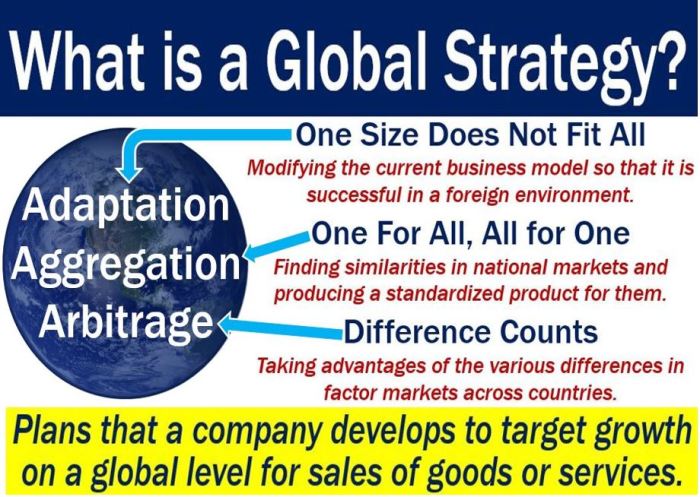
A global business strategy is a comprehensive plan that Artikels how a company will compete in the international marketplace. It encompasses all aspects of a company’s operations, from product development and marketing to production and distribution, tailored to leverage opportunities and mitigate risks in diverse global environments. A successful strategy goes beyond simply exporting products; it requires a deep understanding of international markets, cultural nuances, and competitive landscapes.
Core Components of a Successful Global Business Strategy
Several key elements contribute to the success of a global business strategy. These components are interconnected and require careful consideration and planning. A lack in any one area can significantly impact the overall effectiveness of the strategy.
- Market Analysis: Thorough research identifying target markets with high growth potential and assessing competitive dynamics, consumer preferences, and regulatory environments within those markets.
- Competitive Advantage: Defining a clear and sustainable competitive advantage, whether it’s cost leadership, differentiation, or a niche strategy, that can be effectively leveraged across multiple markets.
- Value Chain Optimization: Strategically locating production facilities, distribution centers, and other elements of the value chain to minimize costs and maximize efficiency across the global operations.
- Global Marketing and Branding: Developing a cohesive global marketing strategy that considers cultural differences and adapts messaging and branding to resonate with local audiences while maintaining brand consistency.
- Risk Management: Identifying and mitigating potential risks associated with global operations, including political instability, currency fluctuations, supply chain disruptions, and intellectual property protection.
Global Strategy versus Multinational Strategy
A global strategy focuses on standardization and efficiency across markets. Products and services are largely uniform, with minor adaptations for local regulations. The emphasis is on economies of scale and central control. In contrast, a multinational strategy emphasizes local responsiveness and adaptation. Products and services are tailored to meet the specific needs and preferences of individual markets.
Decision-making is decentralized, with greater autonomy given to local subsidiaries.
Examples of Companies with Effective Global Strategies
Companies like McDonald’s and Coca-Cola exemplify successful global strategies. McDonald’s adapts its menu slightly to cater to local tastes (e.g., offering teriyaki burgers in Japan), while maintaining its core brand identity and operational efficiency globally. Coca-Cola similarly adjusts its marketing campaigns to resonate with local cultures but keeps its iconic branding consistent worldwide. Their success stems from a balance between standardization and adaptation, effectively managing a global value chain, and strong brand recognition.
Hypothetical Global Business Strategy for an SME
Let’s consider a hypothetical SME, “Artisan Crafts,” specializing in handcrafted wooden toys. Their global business strategy could focus on entering the European market.
- Target Market: Initially, focus on countries with a strong appreciation for handcrafted goods and a robust online retail market, such as Germany and the UK.
- Competitive Advantage: Highlight the unique craftsmanship, sustainability of materials, and ethical sourcing practices.
- Value Chain Optimization: Utilize e-commerce platforms for direct sales, minimizing distribution costs and complexities.
- Global Marketing and Branding: Develop a multilingual website and social media presence showcasing the artistry and quality of the toys. Collaborate with relevant influencers and participate in online craft markets.
- Risk Management: Utilize secure payment gateways and comply with relevant EU regulations regarding product safety and labeling.
Market Entry Strategies
Choosing the right market entry strategy is crucial for businesses aiming to expand globally. The optimal approach depends on various factors, including the company’s resources, the target market’s characteristics, and the nature of the product or service being offered. A careful evaluation of these factors is essential to minimize risks and maximize the chances of success.
Comparison of Global Market Entry Strategies
Several strategies exist for entering global markets, each presenting a unique blend of advantages and disadvantages. These strategies differ significantly in terms of the level of investment, control, and risk involved. A thorough understanding of these nuances is paramount for effective decision-making.
Exporting
Exporting involves selling domestically produced goods or services to customers in other countries. This strategy offers a low-risk, low-cost entry point, requiring minimal initial investment. However, it also offers limited control over distribution and marketing in the foreign market and may expose the company to trade barriers and exchange rate fluctuations. For example, a small bakery might initially export its specialty cakes to nearby countries through an established distributor, minimizing upfront investment but relinquishing some control over pricing and branding.
Joint Ventures
Joint ventures involve collaborating with a local partner to establish a new business entity in the target market. This strategy combines the resources and expertise of both partners, mitigating some of the risks associated with operating independently in a foreign market. However, it also requires sharing control and profits, and potential conflicts may arise due to differing business cultures or strategic goals.
Consider a technology company partnering with a local telecommunications firm to introduce a new mobile application; this allows access to local infrastructure and expertise but necessitates sharing profits and decision-making.
Foreign Direct Investment (FDI)
Foreign direct investment involves establishing a wholly-owned subsidiary or acquiring an existing company in the target market. This strategy provides maximum control over operations and allows for greater customization of products and services to meet local demands. However, it entails significant financial investment and carries a higher level of risk, including exposure to political instability and regulatory changes.
A large automobile manufacturer setting up a manufacturing plant in a new country is a classic example of FDI, offering high control but significant financial commitment and risk.
Licensing and Franchising
Licensing involves granting a foreign company the right to manufacture or sell a product or service under a license agreement. Franchising is a similar strategy where a company grants a foreign entity the right to operate a business under its brand name and system. Both strategies require minimal investment and risk compared to FDI, but they also offer limited control over the operations and quality of the products or services offered.
A well-known coffee chain expanding internationally through franchise agreements demonstrates this approach: low investment for the franchisor, but less control over individual franchise operations.
Decision-Making Framework for Market Entry Strategy Selection
Selecting the optimal market entry strategy requires a systematic approach. A decision-making framework should consider factors such as:
- Market size and growth potential
- Competitive landscape
- Government regulations and trade barriers
- Cultural differences and consumer preferences
- Company resources and capabilities
- Risk tolerance
By carefully assessing these factors, companies can develop a tailored strategy that aligns with their overall business objectives and minimizes potential risks. A weighted scoring model, assigning scores to each factor based on their importance to the specific product or service, can be used to compare different strategies objectively.
Comparison Table of Market Entry Strategies
| Strategy | Risk | Cost | Control |
|---|---|---|---|
| Exporting | Low | Low | Low |
| Joint Venture | Medium | Medium | Medium |
| Foreign Direct Investment | High | High | High |
| Licensing/Franchising | Low to Medium | Low to Medium | Low to Medium |
Global Business Development
Global business development plays a crucial role in achieving a company’s international objectives. It’s the engine driving expansion, market penetration, and ultimately, increased profitability and global market share. Effective business development strategies are essential for navigating the complexities of international markets and fostering sustainable growth.Business development in a global context involves identifying and capitalizing on opportunities beyond domestic markets.
This requires a deep understanding of diverse cultural landscapes, regulatory environments, and competitive dynamics. Success hinges on strategic partnerships, effective resource allocation, and a proactive approach to managing risk.
Business Development Strategies for International Expansion
Several key strategies contribute to successful international expansion. These strategies often intertwine and are adapted to suit specific market conditions and company goals. Choosing the right approach depends on factors like the company’s resources, risk tolerance, and the characteristics of the target market.
- Joint Ventures: This strategy involves collaborating with a local partner to share resources, expertise, and market knowledge. This approach reduces risk and facilitates faster market entry, leveraging the partner’s established networks and understanding of local regulations.
- Strategic Alliances: Similar to joint ventures, but often less formal and focused on specific projects or initiatives. This allows for flexibility and scalability, adapting to changing market conditions and specific needs.
- Foreign Direct Investment (FDI): This involves establishing a wholly-owned subsidiary or acquiring an existing company in the target market. This offers greater control but demands significant capital investment and carries higher risk.
- Franchising: This model grants another entity the right to use the company’s brand, processes, and intellectual property in exchange for fees and royalties. It’s a relatively low-risk approach for rapid expansion, though control over brand consistency can be a challenge.
- Licensing: This involves granting another entity the right to manufacture and sell a company’s product or use its technology in a specific market. This approach is attractive for companies with strong intellectual property but limited resources for international expansion.
Examples of Successful Global Business Development Initiatives
Numerous companies have demonstrated the effectiveness of well-executed global business development strategies. These examples showcase the diverse approaches and the importance of adapting strategies to specific circumstances.
- Starbucks’ Global Expansion: Starbucks’ success exemplifies the power of adapting to local tastes while maintaining brand consistency. They’ve successfully tailored their menu and store designs to suit diverse cultural preferences, creating a global brand with localized appeal.
- IKEA’s Global Supply Chain: IKEA’s efficient global supply chain and strategic partnerships with local suppliers have enabled them to offer affordable furniture worldwide. This illustrates the effectiveness of leveraging global networks to optimize costs and reach a wider audience.
- Unilever’s Sustainable Business Practices: Unilever’s commitment to sustainable sourcing and responsible manufacturing has enhanced their brand reputation and strengthened their relationships with consumers and stakeholders globally. This demonstrates the importance of integrating ethical considerations into global business development.
Developing a New Global Business Partnership
Developing a successful global business partnership requires careful planning and execution. A well-defined process ensures alignment of objectives and minimizes potential conflicts.
- Identify Potential Partners: Thorough research is crucial to identify partners with complementary strengths and a shared vision. This involves assessing their financial stability, market expertise, and cultural compatibility.
- Due Diligence: A comprehensive due diligence process is vital to evaluate the potential partner’s financial health, legal compliance, and operational capabilities. This helps mitigate risks and ensure a sound basis for collaboration.
- Negotiate the Partnership Agreement: A clear and comprehensive agreement outlining the roles, responsibilities, and financial arrangements is essential. This agreement should address intellectual property rights, profit sharing, and dispute resolution mechanisms.
- Establish Clear Communication Channels: Open and regular communication is critical for maintaining a strong partnership. This includes establishing clear reporting lines, regular meetings, and effective communication protocols.
- Monitor and Evaluate Performance: Regular monitoring and evaluation of the partnership’s performance are crucial for identifying areas for improvement and ensuring the partnership remains aligned with its objectives. This involves tracking key performance indicators (KPIs) and adapting strategies as needed.
Successfully navigating the global business landscape demands a multifaceted approach, encompassing strategic planning, astute market analysis, and a commitment to ethical conduct. This exploration has highlighted the critical components of a successful global business strategy, from selecting appropriate market entry methods and building a sustainable competitive advantage to managing the financial and logistical challenges of international expansion. By understanding the interplay of these factors and adapting to the dynamic global environment, businesses can unlock significant opportunities for growth and long-term success.
FAQ Insights
What is the difference between globalization and internationalization?
Globalization refers to the increasing interconnectedness of nations through trade, technology, and cultural exchange. Internationalization, on the other hand, is the process by which a business expands its operations beyond its domestic market.
How can cultural differences impact global business strategy?
Cultural differences significantly impact marketing, communication, and management styles. Understanding and adapting to local customs and preferences is crucial for success.
What are some common risks associated with global expansion?
Common risks include political instability, economic fluctuations, currency exchange rate volatility, regulatory hurdles, and logistical challenges.
What role does technology play in global business strategy?
Technology plays a crucial role, enabling efficient communication, streamlined operations, data-driven decision-making, and access to global markets.


