Successfully navigating the complexities of business growth often hinges on understanding the distinct yet interconnected roles of business development and sales. While both contribute to overall expansion, their approaches, strategies, and ultimate goals differ significantly. This exploration delves into the nuances of each, highlighting their key differences and synergistic potential for achieving remarkable business success.
We’ll examine the core functions of each discipline, the essential skill sets required, and effective strategies for maximizing their combined impact. The discussion will cover key performance indicators (KPIs), collaborative frameworks, and real-world examples across various industries to provide a comprehensive understanding of how businesses can leverage both business development and sales growth for sustained prosperity.
Defining Business Development and Sales Growth
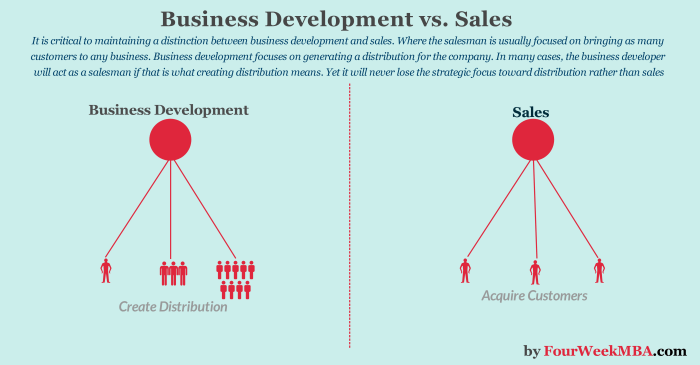
Business development and sales growth are often conflated, but they represent distinct yet complementary functions within an organization. While both contribute to overall revenue and market share, their approaches, objectives, and metrics differ significantly. Understanding these differences is crucial for effective strategic planning and resource allocation.Business development focuses on long-term strategic growth, while sales growth emphasizes short-term revenue generation. Business development activities aim to expand the overall market opportunity for a company, whereas sales growth focuses on converting existing opportunities into sales.
This distinction is vital for understanding the different roles and responsibilities within a company.
Business Development and Sales Growth: Distinct Roles and Objectives
Business development aims to identify and cultivate new opportunities for revenue generation. This includes exploring new markets, developing strategic partnerships, identifying potential acquisitions, and innovating new products or services. The objective is to create a sustainable pipeline of future revenue streams and strengthen the company’s long-term competitive position. In contrast, sales growth concentrates on maximizing current revenue through effective sales strategies, lead generation, and customer relationship management.
The objective is to increase immediate sales figures and improve market penetration within existing markets. A successful business development strategy will ultimately feed into a stronger sales pipeline, driving sales growth.
Key Performance Indicators (KPIs) for Business Development and Sales Growth
Measuring success in business development and sales growth requires different KPIs. For business development, key metrics might include the number of strategic partnerships formed, the value of potential acquisition targets identified, the number of new market entries, and the successful launch of innovative products or services. These KPIs reflect the long-term impact of business development initiatives. Conversely, sales growth is typically measured by metrics such as revenue growth, conversion rates, customer acquisition cost, average order value, and customer lifetime value.
These KPIs provide a direct measure of short-term sales performance. A balanced scorecard approach, incorporating both short-term sales and long-term development KPIs, offers a comprehensive view of organizational success.
Skill Sets for Business Development and Sales Professionals
The skill sets required for business development and sales professionals differ considerably. Business development professionals typically need strong strategic thinking skills, market research capabilities, negotiation skills, and the ability to build and manage relationships with external stakeholders. They need to be adept at identifying emerging trends and translating them into actionable business strategies. Sales professionals, on the other hand, require strong communication, persuasion, and closing skills.
They need to be highly effective at building rapport with customers, understanding their needs, and guiding them through the sales process. While both roles benefit from strong interpersonal skills, the focus of those skills differs significantly. Business development professionals often focus on relationship building with external partners, while sales professionals focus on building relationships with potential and existing customers.
The Relationship Between Business Development and Sales Growth
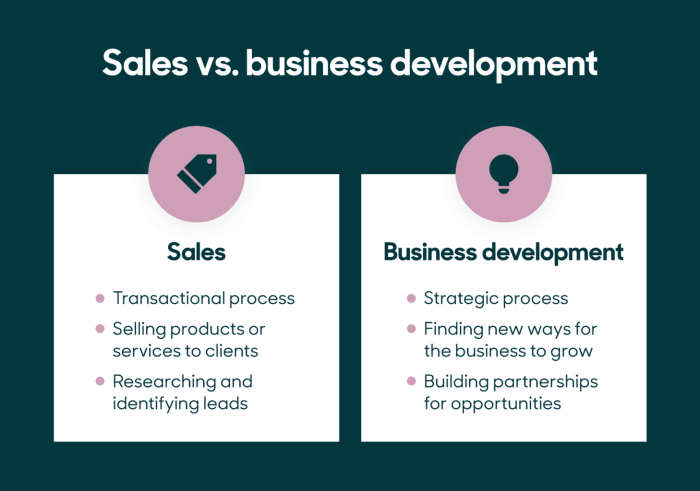
Business development and sales growth are intrinsically linked; a robust business development function significantly fuels sales expansion. Effective business development lays the groundwork for sustainable sales increases by identifying and cultivating new opportunities, strengthening market position, and enhancing brand reputation. Without a strong foundation built by business development, sales teams often struggle to achieve consistent, long-term growth.Effective business development strategies directly contribute to sales growth by expanding the addressable market, improving lead generation, and enhancing customer relationships.
By proactively identifying new market segments, developing strategic partnerships, and innovating product offerings, business development teams create a pipeline of qualified leads for the sales team to convert. This proactive approach shifts the sales team’s focus from solely closing deals to nurturing existing relationships and expanding into new territories, ultimately increasing revenue streams.
Synergistic Relationships Between Business Development and Sales Teams
A successful collaboration between business development and sales teams is characterized by shared goals, open communication, and mutual respect. Sales teams benefit from the insights and leads generated by business development, while business development teams gain valuable feedback from sales on market trends and customer needs. This reciprocal exchange of information and expertise creates a powerful engine for growth.For example, imagine a software company.
The business development team identifies a new niche market through thorough market research and develops a targeted marketing campaign. This campaign generates high-quality leads, which are then passed to the sales team. The sales team, armed with insights from business development about the specific needs of this niche, can tailor their pitch and close deals more effectively. Conversely, feedback from the sales team on customer challenges and unmet needs informs the business development team’s strategy for future product development and market expansion.
This cyclical process ensures continuous improvement and sustainable growth.
A Collaborative Framework for Maximizing Impact
A structured framework is essential to maximize the synergistic potential of business development and sales teams. This framework should include clearly defined roles and responsibilities, regular communication channels, and shared performance metrics. A well-defined framework could involve weekly joint meetings to review progress, share insights, and address challenges. Key performance indicators (KPIs) should be established and tracked collaboratively, ensuring both teams are aligned on success metrics, such as lead generation, conversion rates, and revenue growth.
Regular feedback sessions allow for continuous improvement and adjustment of strategies based on real-time data. This collaborative approach ensures both teams are working in concert to achieve shared goals, leading to significantly greater sales growth than either team could achieve independently.
Business Development and Related Concepts
Business development, while encompassing many strategies for growth, is inextricably linked to several key concepts that significantly influence its success. Understanding these relationships allows for a more holistic and ethical approach to achieving business objectives. This section explores the interconnectedness of business development with business ethics, coaching, financing, diverse business models, strategic planning, and business travel.
Business Development and Business Ethics
Maintaining ethical standards is paramount in business development. Ethical dilemmas can arise in areas such as aggressive marketing tactics, questionable partnerships, or prioritizing short-term gains over long-term sustainability. For instance, a company might be tempted to cut corners on product quality to reduce costs and increase profits, potentially jeopardizing consumer trust and brand reputation. Conversely, a commitment to ethical sourcing and fair labor practices can significantly enhance a company’s image and attract customers who value ethical consumption.
Transparency, honesty, and integrity in all business dealings are crucial for building lasting relationships with stakeholders and fostering sustainable growth. Ethical lapses, however, can lead to significant reputational damage, legal repercussions, and ultimately, business failure.
The Role of Business Coaching in Enhancing Business Development Skills
Business coaching provides tailored guidance and support to individuals and teams involved in business development. Coaches help refine strategies, improve communication, and overcome obstacles. A coach might work with a sales team to improve their lead generation techniques, or with a marketing team to develop a more effective brand strategy. The personalized approach of coaching enables individuals to identify and leverage their strengths, while addressing weaknesses that hinder their effectiveness in achieving business goals.
The measurable impact of coaching is seen in increased productivity, improved team dynamics, and ultimately, enhanced business development outcomes.
Business Loans and Business Development Initiatives
Access to capital is often a critical factor in successful business development. Business loans provide the financial resources needed to fund expansion, invest in new technologies, hire additional staff, or develop new products or services. For example, a small startup might secure a loan to purchase essential equipment, while an established company might use financing to expand into a new market.
However, securing loans requires a robust business plan demonstrating the viability of the proposed initiatives and the ability to repay the debt. Careful consideration of loan terms and conditions is essential to ensure that the financing supports, rather than hinders, long-term business growth.
Comparison of Different Business Models and Their Impact on Business Development
Different business models—such as B2B (business-to-business), B2C (business-to-consumer), franchise, subscription, and freemium—each present unique opportunities and challenges for business development. A B2B model, for example, typically focuses on building strong relationships with key clients, while a B2C model might emphasize brand building and mass-market appeal. The chosen model significantly influences marketing strategies, sales processes, and overall business development efforts.
A company’s choice of business model should align with its target market, resources, and long-term strategic goals. A poorly chosen model can limit growth potential, while a well-aligned model can significantly accelerate development.
Business Strategy and Business Development Activities
Effective business development is driven by a clear and well-defined business strategy. The strategy Artikels the company’s vision, mission, goals, and the steps required to achieve them. Business development activities should be directly aligned with the strategic objectives. For instance, a company aiming for market leadership might focus on aggressive expansion and product innovation, while a company prioritizing profitability might emphasize cost optimization and operational efficiency.
A strong strategy provides direction, prioritizes efforts, and ensures that business development initiatives contribute to the overall success of the organization. Without a clear strategy, business development efforts can become fragmented and unproductive.
The Importance of Business Travel in Fostering Business Development
Business travel plays a vital role in building relationships, exploring new markets, and closing deals. Face-to-face interactions are often more effective than virtual communication, particularly in building trust and rapport with clients and partners. Attending industry conferences and trade shows provides opportunities for networking and learning about industry trends. Site visits to potential clients or suppliers can facilitate deeper understanding and stronger collaboration.
While the costs associated with business travel are significant, the potential return on investment in terms of strengthened relationships and expanded business opportunities often justifies the expense. However, careful planning and efficient travel management are crucial to maximize the benefits and minimize costs.
In conclusion, while business development and sales growth represent distinct functions, their successful integration is crucial for sustainable business expansion. By fostering collaboration, aligning strategies, and leveraging the strengths of each discipline, organizations can unlock significant growth opportunities. Understanding the unique contributions of each, coupled with a strategic approach to measurement and continuous improvement, will pave the way for achieving ambitious business objectives.
Frequently Asked Questions
What is the primary difference between a business development representative and a sales representative?
Business development focuses on long-term strategic growth, identifying new opportunities and building relationships. Sales focuses on closing deals and achieving immediate revenue targets.
How can I measure the effectiveness of my business development efforts?
Track key metrics such as lead generation, pipeline growth, number of strategic partnerships formed, and market share expansion. Qualitative assessments of brand awareness and market positioning are also valuable.
What are some common pitfalls to avoid when integrating business development and sales?
Poor communication, conflicting priorities, lack of clearly defined roles and responsibilities, and inadequate measurement of combined impact are common pitfalls.
How can I foster better collaboration between business development and sales teams?
Implement regular joint meetings, share data and insights transparently, establish shared goals and KPIs, and create cross-functional training opportunities.


