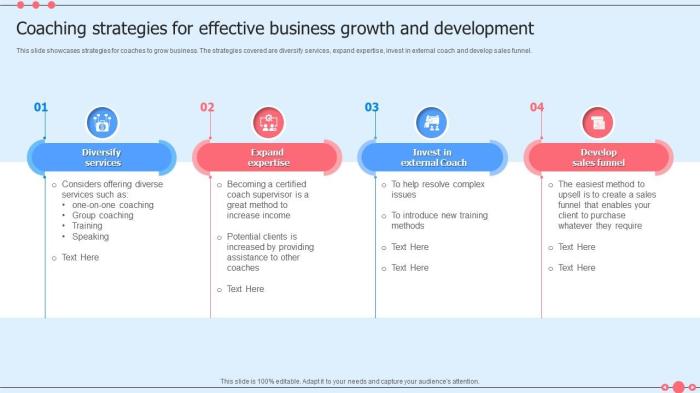
Navigating the complexities of business growth can feel overwhelming. This exploration of business coaching provides a roadmap to success, examining proven strategies, ethical considerations, and financial planning for sustainable expansion. We’ll delve into practical techniques to identify growth opportunities, implement effective development strategies, and leverage resources to achieve ambitious goals.
From understanding key performance indicators (KPIs) and market analysis to mastering business development strategies like market penetration and diversification, this guide offers a comprehensive framework. We’ll also discuss the crucial role of ethical practices and responsible financing, ensuring sustainable and impactful growth.
Defining Business Coaching for Growth
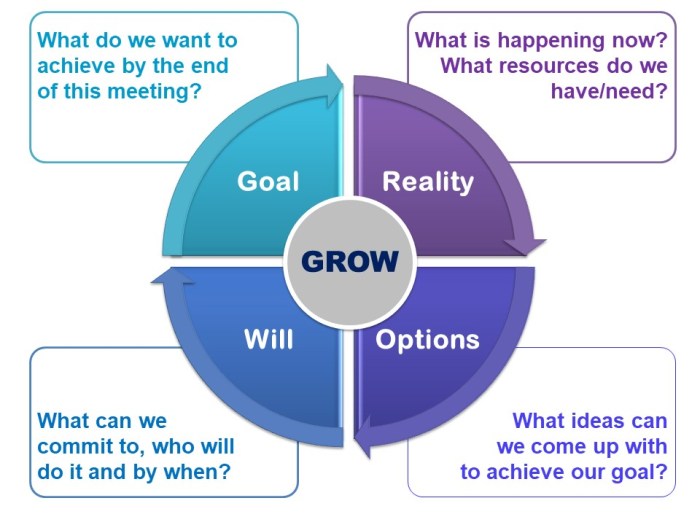
Business coaching for growth focuses on accelerating the performance and profitability of businesses through individualized guidance and strategic support. It’s a collaborative process where a skilled coach works with business owners and leaders to identify challenges, unlock potential, and achieve ambitious goals. This differs significantly from simply providing advice; it’s about empowering the client to discover their own solutions and build sustainable growth strategies.
Core Principles of Business Coaching Focused on Growth
Effective business coaching for growth rests on several key principles. Firstly, it emphasizes a strong coach-client relationship built on trust and open communication. This allows for honest assessments and the development of tailored strategies. Secondly, it promotes self-discovery and empowerment, enabling clients to identify their strengths and weaknesses and develop their leadership capabilities. Thirdly, it focuses on action-oriented strategies, translating insights into tangible plans and measurable results.
Finally, it provides ongoing support and accountability, ensuring clients stay on track and achieve their objectives. These principles work together to foster sustainable business growth and long-term success.
Types of Business Coaching Programs
Various business coaching programs cater to diverse needs and business stages. Executive coaching focuses on developing leadership skills and strategic thinking for senior executives. Sales coaching concentrates on improving sales techniques and team performance. Marketing coaching helps businesses enhance their marketing strategies and brand building. Financial coaching assists in improving financial management and profitability.
Finally, operational coaching focuses on streamlining business processes and increasing efficiency. The choice of program depends on the specific challenges and goals of the business.
Comparison of Business Coaching and Business Consulting
While both business coaching and business consulting aim to improve business performance, they differ significantly in their approach. Business consulting typically involves providing expert advice and solutions to specific business problems, often involving external analysis and recommendations. Business coaching, conversely, focuses on developing the client’s internal capabilities and empowering them to find their own solutions. Consultants
- tell* you what to do; coaches
- help you discover* what to do. Consultants often deliver a finished product or report; coaches guide a process of continuous improvement.
Examples of Successful Business Coaching Case Studies
Consider a small bakery struggling with inconsistent sales. A business coach might work with the owner to analyze sales data, identify peak demand periods, and develop a targeted marketing strategy. This could involve refining their online presence, implementing a loyalty program, or exploring new product lines. The result could be a significant increase in sales and customer loyalty. Another example is a tech startup facing challenges in scaling its operations.
A coach might guide the founders through strategic planning, team building, and process optimization, ultimately leading to increased efficiency and sustainable growth. These examples demonstrate how coaching empowers businesses to overcome specific obstacles and achieve lasting success.
Comparison of Benefits and Costs of Various Coaching Approaches
| Coaching Approach | Benefits | Costs | Suitable For |
|---|---|---|---|
| Executive Coaching | Improved leadership, strategic thinking, enhanced decision-making | Higher fees, significant time commitment | Senior executives, CEOs |
| Sales Coaching | Increased sales revenue, improved sales team performance | Moderate fees, ongoing training investment | Sales teams, sales managers |
| Marketing Coaching | Enhanced brand awareness, improved marketing ROI | Moderate fees, potential marketing budget increases | Marketing teams, business owners |
| Financial Coaching | Improved financial management, increased profitability | Moderate to high fees, depending on complexity | Business owners, finance teams |
Identifying Growth Opportunities
Unlocking your business’s full potential requires a proactive approach to identifying and capitalizing on growth opportunities. This involves a systematic analysis of your current performance, a keen understanding of market dynamics, and the implementation of strategic improvements across your operations. By focusing on these key areas, you can create a roadmap for sustainable and significant growth.
Key Performance Indicators (KPIs) for Growth
Understanding which metrics truly reflect your business’s health is crucial for effective growth planning. Focusing on the wrong KPIs can lead to misdirected efforts and wasted resources. Therefore, selecting the right indicators is paramount. Relevant KPIs should directly correlate with your overall growth objectives and provide actionable insights.
- Revenue Growth Rate: This fundamental KPI measures the percentage increase in revenue over a specific period, indicating the overall trajectory of your business. A consistently increasing revenue growth rate signals a healthy and expanding business.
- Customer Acquisition Cost (CAC): This metric reveals the cost of acquiring a new customer. Lowering your CAC while maintaining or increasing customer lifetime value is vital for profitability and sustainable growth.
- Customer Lifetime Value (CLTV): This KPI represents the total revenue a customer is expected to generate throughout their relationship with your business. A high CLTV indicates customer loyalty and a strong revenue stream.
- Market Share: This metric reflects your business’s portion of the total market. An increasing market share suggests a successful expansion of your reach and influence within your industry.
Analyzing Market Trends and Untapped Potential
A thorough understanding of market trends and the identification of untapped potential are essential for informed decision-making. This requires both internal and external analysis. By identifying emerging trends, you can proactively adapt your strategies and capitalize on new opportunities before your competitors.Market analysis involves several methods: conducting thorough market research, analyzing competitor strategies, monitoring industry publications and news, and utilizing data analytics to identify patterns and trends.
Untapped potential can often be found in underserved niches, emerging technologies, or geographical expansion. For example, a local bakery might identify untapped potential by offering online ordering and delivery, catering to a wider customer base.
Strategies for Improving Operational Efficiency
Streamlining operations and enhancing efficiency are critical for maximizing profitability and supporting growth. This involves identifying bottlenecks, optimizing processes, and leveraging technology to improve productivity. For instance, implementing a Customer Relationship Management (CRM) system can significantly improve customer service, streamline sales processes, and improve overall operational efficiency.Examples of efficiency-boosting strategies include: automating repetitive tasks, optimizing supply chain management, improving inventory control, and investing in employee training and development.
A well-structured workflow and clear communication channels also play a significant role in improving operational efficiency.
Framework for Setting Realistic and Measurable Growth Goals
Setting SMART goals – Specific, Measurable, Achievable, Relevant, and Time-bound – is crucial for effective growth planning. Vague goals lead to ineffective strategies and hinder progress. A well-defined framework ensures that goals are realistic, attainable, and aligned with the overall business objectives. This includes establishing clear targets, outlining the steps needed to achieve those targets, and setting timelines for completion.
For example, instead of setting a goal of “increase sales,” a SMART goal would be “increase sales by 15% in the next quarter by implementing a new marketing campaign targeting a specific demographic.”
Examples of Innovative Growth Strategies
Businesses are constantly seeking innovative ways to achieve rapid growth. These strategies often involve leveraging technology, adapting to changing market conditions, and focusing on customer experience. For example, subscription-based models offer predictable revenue streams and foster customer loyalty. Another example is the use of influencer marketing to reach a wider audience and increase brand awareness. Companies using agile methodologies and data-driven decision-making often show faster growth rates compared to those using traditional approaches.
Netflix’s shift from DVD rentals to streaming and Amazon’s expansion into diverse market segments are prime examples of innovative strategies driving rapid growth.
Business Development Strategies
Sustainable growth isn’t accidental; it’s the result of strategic planning and execution. Business development plays a pivotal role in this process, acting as the engine that drives expansion and profitability. It involves identifying opportunities, developing strategies to capitalize on them, and implementing those strategies effectively. This section explores various business development strategies and provides a framework for their implementation.
The Role of Business Development in Achieving Sustainable Growth
Business development is crucial for sustainable growth because it focuses on proactively shaping a company’s future rather than simply reacting to market changes. By systematically identifying and pursuing new opportunities, businesses can expand their market reach, increase revenue streams, and enhance their competitive advantage. This proactive approach ensures consistent growth, even in challenging economic climates. A well-defined business development strategy allows companies to anticipate trends, adapt to shifting market demands, and consistently achieve long-term, sustainable growth.
It’s about more than just making a sale; it’s about building a resilient and future-proof business.
Different Business Development Strategies
Several key strategies contribute to effective business development. Understanding these options and their implications is vital for choosing the right approach for a specific business.
- Market Penetration: This involves increasing market share within existing markets using existing products. Strategies include intensifying marketing efforts, improving customer service, and implementing competitive pricing strategies. For example, a coffee shop might implement a loyalty program to encourage repeat business from existing customers.
- Product Development: This strategy focuses on creating new products or significantly improving existing ones to appeal to current or new markets. An example would be a software company releasing a new version of its software with enhanced features to attract both existing and new customers.
- Market Development: This involves expanding into new markets with existing products. A clothing brand, for instance, might expand its online presence to reach a broader international customer base.
- Diversification: This is a more aggressive strategy involving entering new markets with new products or services. This approach spreads risk and can lead to significant growth but also carries higher risk. A food company might diversify by launching a new line of organic snacks, targeting a health-conscious market segment.
Comparison of Business Development Models
Various models exist for approaching business development, each with its own strengths and weaknesses. The choice depends heavily on the specific business context, resources, and risk tolerance.
| Model | Description | Advantages | Disadvantages |
|---|---|---|---|
| Organic Growth | Internal expansion through existing resources | Lower risk, better control | Slower growth, limited reach |
| Acquisition | Purchasing another company | Rapid market entry, access to resources | High cost, integration challenges |
| Joint Venture | Partnership with another company | Shared resources, reduced risk | Loss of control, potential conflicts |
| Franchising | Licensing the business model to others | Rapid expansion, reduced investment | Less control over operations, brand consistency challenges |
Step-by-Step Plan for Implementing a Business Development Strategy
Successful implementation requires a structured approach.
- Define Objectives: Clearly state the desired outcomes of the business development initiative, including specific, measurable, achievable, relevant, and time-bound (SMART) goals.
- Market Research: Conduct thorough market research to understand the target market, competitive landscape, and potential opportunities.
- Strategy Selection: Choose the most appropriate business development strategy based on the research and objectives.
- Resource Allocation: Allocate necessary resources, including budget, personnel, and technology, to support the chosen strategy.
- Implementation Plan: Develop a detailed implementation plan with timelines, milestones, and responsibilities.
- Monitoring and Evaluation: Regularly monitor progress, track key metrics, and evaluate the effectiveness of the strategy. Adjust as needed.
Examples of Successful Business Development Initiatives
Many companies have successfully implemented business development strategies. For example, Starbucks’ expansion into international markets through franchising and market development is a classic case of successful diversification. Similarly, Apple’s consistent product development, releasing innovative new products and services, has fueled its remarkable growth. These successes highlight the importance of strategic planning, market understanding, and adaptive implementation.
The Role of Business Ethics in Growth
Sustainable business growth isn’t solely about maximizing profits; it’s inextricably linked to ethical conduct. A strong ethical foundation builds trust with customers, employees, and investors, fostering long-term success and resilience. Conversely, neglecting ethical considerations can lead to significant damage to a company’s reputation and bottom line.Ethical considerations are paramount in developing and implementing effective business growth strategies. Ignoring these aspects can lead to short-term gains but ultimately undermines long-term sustainability and profitability.
A robust ethical framework ensures responsible decision-making at all levels, contributing to a positive and productive work environment and fostering strong relationships with stakeholders.
Potential Consequences of Unethical Business Practices
Unethical business practices carry substantial risks. These can range from hefty fines and legal battles to irreparable damage to brand reputation and loss of consumer trust. For example, a company engaging in deceptive advertising or price gouging may face severe penalties and a significant decline in customer loyalty. The erosion of public trust can be difficult, if not impossible, to overcome, ultimately hindering future growth prospects.
Furthermore, unethical behavior can negatively impact employee morale and lead to high turnover rates, increasing recruitment and training costs. The negative publicity associated with such practices can also deter potential investors, making it harder to secure funding for expansion.
Ethical Dilemmas Faced by Growing Businesses
Rapid growth often presents unique ethical challenges. One common dilemma involves prioritizing profit maximization over employee well-being, such as pushing employees to work excessive hours without adequate compensation or benefits. Another challenge lies in balancing the need for aggressive competition with maintaining fair and ethical business practices. This can manifest as engaging in unfair pricing strategies or employing questionable marketing tactics to gain a competitive edge.
Additionally, growing businesses may face dilemmas concerning data privacy and security, particularly as they collect and utilize increasing amounts of customer information. Maintaining transparency and ethical data handling practices are crucial to building and maintaining customer trust.
Best Practices for Maintaining Ethical Standards
Establishing and maintaining high ethical standards requires a proactive and comprehensive approach. This begins with developing a clear and concise code of ethics, communicated effectively to all employees and stakeholders. Regular ethics training programs are essential to reinforce ethical principles and provide guidance on navigating complex situations. Furthermore, implementing robust internal controls and reporting mechanisms enables the detection and prevention of unethical behavior.
Transparency in business operations is also crucial, allowing stakeholders to understand the company’s ethical commitments and practices. Regular ethical audits and assessments can help identify potential vulnerabilities and ensure continuous improvement in ethical performance. Finally, fostering a culture of ethical decision-making, where employees feel empowered to speak up about concerns, is paramount to creating a sustainable and responsible business.
A Hypothetical Code of Ethics
This code of ethics Artikels the guiding principles for [Company Name], a hypothetical growing business.
We are committed to conducting our business with the highest ethical standards, fostering a culture of integrity, respect, and responsibility.
- Integrity: We will act honestly and transparently in all our dealings, upholding the truth and avoiding any form of deception.
- Respect: We will treat all our stakeholders—employees, customers, suppliers, and the community—with dignity and fairness, valuing diversity and inclusivity.
- Responsibility: We will be accountable for our actions and decisions, striving to minimize our environmental impact and contribute positively to society.
- Compliance: We will adhere to all applicable laws, regulations, and industry best practices.
- Fairness: We will engage in fair competition, avoiding any practices that could harm our competitors or undermine market integrity.
Financing Growth
Securing adequate funding is crucial for any business aiming for expansion. Understanding the various financing options available and their implications is paramount for making informed decisions that support sustainable growth. This section will explore different business loan types, compare their advantages and disadvantages, detail the loan application process, and illustrate the creation of a financial model for expansion, supported by real-world examples.
Types of Business Loans
Businesses have access to a range of loan options, each tailored to specific needs and financial situations. The choice depends on factors such as the business’s credit history, the amount of funding required, and the intended use of funds. Common types include term loans, lines of credit, SBA loans, and equipment financing. Term loans provide a fixed amount of money for a specific period, with regular repayments.
Lines of credit offer flexible access to funds up to a pre-approved limit, allowing businesses to borrow and repay as needed. SBA loans, backed by the Small Business Administration, offer favorable terms for small businesses, often with lower interest rates and longer repayment periods. Equipment financing specifically funds the purchase of equipment, with the equipment itself serving as collateral.
Advantages and Disadvantages of Financing Options
Each financing option presents unique advantages and disadvantages. Term loans offer predictability with fixed payments, but can be inflexible if needs change. Lines of credit provide flexibility but may have higher interest rates than term loans. SBA loans offer favorable terms but involve a more rigorous application process. Equipment financing is convenient for acquiring assets but may limit funding for other business needs.
A thorough cost-benefit analysis is crucial before committing to any financing option. For example, a fast-growing tech startup might prefer a line of credit for its flexibility, while a stable manufacturing company might opt for a term loan for predictable payments.
Securing a Business Loan
The process of securing a business loan typically involves several steps. First, businesses need to prepare a comprehensive business plan outlining their financial projections, growth strategy, and management team. Next, they should compile their financial statements, including profit and loss statements, balance sheets, and cash flow statements, to demonstrate their financial health. Credit history is also a crucial factor, as lenders assess the business’s creditworthiness.
Finally, the business will need to present their loan application to potential lenders, which might include banks, credit unions, or online lenders. A strong application with a clear business plan and sound financials significantly increases the chances of loan approval.
Designing a Financial Model for Expansion
A robust financial model is essential for securing funding and guiding expansion efforts. The model should project revenue, expenses, and cash flow over a specified period, usually 3-5 years. It should incorporate assumptions about market growth, pricing strategies, and operating costs. Key metrics such as break-even point, return on investment (ROI), and net present value (NPV) should be included.
For example, a model for a restaurant expansion might project increased revenue based on market analysis and anticipated customer growth, factoring in expenses like rent, labor, and food costs. The model should clearly demonstrate the financial viability of the expansion plan and its potential for return. A well-structured model improves the chances of securing funding and helps in making informed decisions.
Examples of Successful Businesses Leveraging Financing for Growth
Many successful businesses have strategically used financing to fuel their growth. Starbucks, for example, utilized a combination of debt and equity financing to expand its operations globally. Similarly, companies like Apple have used various financial instruments to invest in research and development, leading to innovative products and market dominance. These examples highlight the importance of strategic financial planning and the ability to leverage different financing options to achieve ambitious growth targets.
It’s crucial to remember that the specific financing strategy needs to be tailored to the individual business and its circumstances.
Business Strategy and Planning for Growth
A robust business strategy is the cornerstone of sustainable growth. It provides a roadmap, guiding decision-making and resource allocation to achieve ambitious goals. This strategy must be adaptable and responsive to market changes, ensuring the business remains competitive and profitable in the long term. A well-defined strategy translates vision into actionable steps.
Components of a Comprehensive Business Strategy for Growth
A comprehensive business strategy for growth encompasses several key components. These include a clear definition of the target market, a competitive analysis identifying strengths and weaknesses relative to competitors, a detailed value proposition outlining the unique benefits offered to customers, a well-defined marketing and sales plan to reach the target audience, and a financial model projecting revenue, expenses, and profitability.
Finally, a robust operational plan Artikels the processes and resources needed to deliver the value proposition efficiently. The integration of these components ensures a cohesive and effective strategy.
Developing a Strategic Plan: SWOT Analysis and Market Research
The process of developing a strategic plan begins with thorough market research to understand customer needs, market trends, and competitive landscapes. This research informs the SWOT analysis – evaluating internal Strengths and Weaknesses, and external Opportunities and Threats. This analysis provides a realistic assessment of the business’s current position and potential for growth. Following the SWOT analysis, specific objectives are set, outlining measurable goals for growth.
These objectives are then translated into actionable strategies and tactics, including marketing campaigns, product development initiatives, and operational improvements. Regular monitoring and evaluation of progress are crucial to ensure the plan remains relevant and effective.
Comparison of Strategic Planning Frameworks
Several strategic planning frameworks exist, each offering a unique approach. The Porter’s Five Forces model, for instance, analyzes industry attractiveness by examining competitive rivalry, supplier power, buyer power, threat of substitutes, and threat of new entrants. The Balanced Scorecard framework, on the other hand, considers perspectives beyond financial performance, incorporating customer satisfaction, internal processes, and learning & growth.
While the Ansoff Matrix focuses on growth strategies through market penetration, market development, product development, and diversification. The choice of framework depends on the specific needs and context of the business. Each framework offers valuable insights, but a tailored approach combining elements from different models can be highly effective.
Strategic Plan for a Hypothetical Business: Expansion
Let’s consider a hypothetical bakery aiming for expansion. Their SWOT analysis reveals strong brand recognition (Strength) but limited production capacity (Weakness). Opportunities include expanding into a new geographic market and offering online ordering (Opportunities). Threats include increasing competition and rising ingredient costs (Threats). Their strategic plan might involve securing additional funding (to address the weakness), launching a targeted marketing campaign in the new market (to leverage the opportunity), and implementing efficient inventory management (to mitigate the threat of rising costs).
This plan will include specific, measurable, achievable, relevant, and time-bound (SMART) goals, such as increasing sales by 25% within the next year.
Examples of Successful Business Strategies
Many companies have achieved significant growth through well-executed strategies. Netflix’s shift from DVD rentals to streaming video on demand disrupted the entertainment industry, leading to massive growth. Similarly, Apple’s focus on design and user experience, coupled with innovative product development, has propelled it to become a global tech giant. These examples highlight the importance of adaptability, innovation, and a customer-centric approach in achieving sustained growth.
Both companies successfully identified market trends and adapted their strategies to capitalize on opportunities.
Business Travel and its Impact on Growth
Business travel, while often perceived as an expense, plays a crucial role in driving business growth and fostering strong relationships. It offers opportunities for face-to-face interactions that are often more effective than virtual communication, particularly when building trust and rapport with clients, partners, and employees. Strategic business travel can significantly enhance a company’s bottom line by opening doors to new opportunities and solidifying existing partnerships.Effective business travel planning and management are paramount to maximizing its benefits and minimizing potential disruptions.
Poorly planned trips can lead to wasted time, missed opportunities, and increased costs. A well-structured approach ensures that travel aligns with overall business objectives and contributes positively to the company’s growth trajectory.
Effective Business Travel Planning and Management
Effective business travel planning involves meticulous preparation, encompassing flight and accommodation bookings, itinerary scheduling, and visa or other travel document acquisition well in advance. It also includes contingency planning for potential disruptions, such as flight delays or cancellations. Utilizing travel management tools and booking platforms can streamline the process, improve efficiency, and often secure better deals. Regular review of travel policies and procedures ensures compliance and cost optimization.
For example, a company might implement a policy favoring direct flights to minimize travel time and associated costs, or prioritize using preferred hotel chains to leverage negotiated corporate rates.
Optimizing Business Travel Expenses
Optimizing business travel expenses requires a multi-pronged approach. This includes negotiating favorable rates with airlines and hotels, utilizing loyalty programs to earn points and discounts, and implementing strict expense reporting policies. Careful consideration of travel class and accommodation choices can significantly impact overall costs, without necessarily compromising productivity. For instance, opting for economy class flights on shorter trips can yield substantial savings, while booking accommodations in strategically located, budget-friendly hotels can reduce expenses without sacrificing convenience.
Implementing a robust expense management system can further help track spending and identify areas for potential cost reduction.
Comparison of Business Travel Modes and Their Impact on Productivity
Different modes of business travel – air travel, train travel, and car travel – each offer varying degrees of speed, comfort, and cost-effectiveness. Air travel is typically the fastest option for long distances, but can be more expensive and stressful. Train travel offers a more comfortable and often more productive alternative for shorter to medium distances, allowing for work to be completed during transit.
Car travel offers flexibility but can be time-consuming, particularly over long distances. The choice of travel mode should be determined by factors such as distance, time constraints, budget, and the need for productivity during travel. For example, a sales team traveling to multiple client meetings across a region might find car travel more efficient, while a team attending a major industry conference in a distant city would likely opt for air travel.
Examples of Business Travel’s Contribution to Business Success
Numerous businesses have benefited significantly from strategic business travel. For example, a small software company’s participation in a major industry trade show, requiring extensive business travel for its sales team, led to several significant contracts and a substantial increase in revenue. Similarly, a consulting firm’s investment in frequent client visits, facilitated by effective business travel planning, fostered strong client relationships and resulted in repeat business and referrals.
These examples illustrate how well-planned and executed business travel can be a powerful catalyst for growth and success.
Ultimately, successful business growth hinges on a combination of strategic planning, operational efficiency, and ethical conduct. By understanding the core principles of business coaching and applying the strategies Artikeld here, businesses can unlock their full potential and achieve lasting success. Remember, consistent self-assessment and adaptation are key to navigating the ever-evolving business landscape.
FAQ Resource
What is the typical duration of a business coaching program?
The length varies widely, ranging from a few months to several years, depending on the client’s needs and goals.
How much does business coaching cost?
Pricing depends on the coach’s experience, program length, and the scope of services. Expect a range from a few hundred to several thousand dollars per month.
How do I find a qualified business coach?
Look for coaches with relevant experience, certifications, and positive client testimonials. Networking and online research are valuable tools.
What if my business isn’t experiencing any immediate growth challenges? Should I still consider coaching?
Proactive coaching can help identify and address potential issues before they become significant obstacles. It’s also valuable for setting ambitious goals and refining existing strategies.


